Laravel API Best Practices: 15 Rules for Production APIs in 2026
Design and ship a Laravel API that scales — versioning, Sanctum auth, rate limits, pagination, error format, OpenAPI, and testing.
TL;DR
A production Laravel API has 15 non-negotiable properties. Miss any one and you will pay for it later in support, security incidents, or migration pain.
The 15 rules
- Version your routes.
/api/v1/orders. Never/api/orders. - Auth = Sanctum for first-party, Passport (OAuth2) for third-party.
- Rate limit every route.
Route::middleware('throttle:60,1'). - Return JSON:API-shaped errors with
errors[].code,errors[].detail. - Paginate by cursor, not offset, once tables cross 100k rows.
- Use Form Requests for validation — one class per endpoint.
- Use API Resources to control what leaves the server.
- Never expose internal IDs alone — pair with slug or ULID.
- Idempotency keys on POSTs that create money-moving resources.
- CORS: whitelist origins, never
*when cookies are involved. - Log request IDs — add a middleware setting
X-Request-Id. - Health endpoint
/api/healthreturning DB + queue + Redis status. - OpenAPI spec generated from code.
- Feature tests, not unit tests, for API surface.
- Deprecation headers before removing anything.
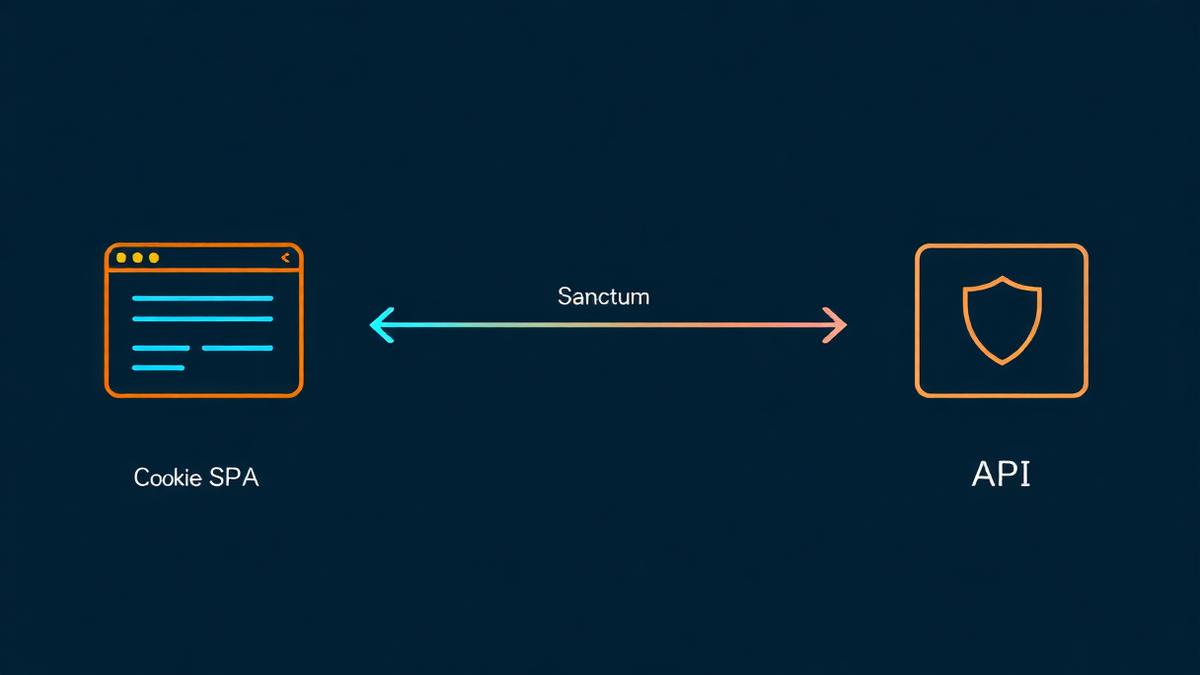
Sanctum + SPA in 30 lines
Route::middleware('auth:sanctum')->group(function () {
    Route::apiResource('orders', OrderController::class);
});
Standard error envelope
{
  "errors": [{
    "status": "422",
    "code": "validation_failed",
    "detail": "The email has already been taken."
  }]
}
FAQ
JSON:API or custom? JSON:API if you have public consumers, custom if internal.
Sanctum or Passport? Sanctum for SPA/mobile. Passport when you need full OAuth2.
How do I handle file uploads? Presigned S3 URLs — never proxy uploads through Laravel.
Key takeaways
- Laravel API best practices include strict versioning for stability.
- Secure your APIs with Sanctum or Passport for robust authentication.
- Implement rate limiting to prevent abuse and ensure API stability.
- Standardize error responses using JSON:API for clear communication.
- Optimize performance with cursor pagination for large datasets.
- Automate validation with Form Requests for maintainable code.
Why Laravel API Best Practices are Crucial for Scalable Systems
Adhering to Laravel API best practices is crucial for developing scalable, secure, and maintainable systems in 2026. These practices not only optimize performance but also significantly reduce technical debt and potential security vulnerabilities. Without a solid foundation, an API can quickly become a bottleneck, slowing down application development and frustrating both developers and end-users. Embracing these guidelines ensures your Laravel API can handle increasing loads and evolving requirements.
For instance, proper API versioning (rule #1) is vital for ensuring backward compatibility, allowing old clients to continue functioning while new features are rolled out to newer clients. Without this, every API change risks breaking existing integrations, leading to significant support overhead and potential service disruptions. Similarly, robust authentication and authorization mechanisms (rule #2) are non-negotiable, protecting sensitive data and ensuring only authorized users can access specific endpoints.
Real-world example
Imagine building a financial transaction API for a neobank using Laravel. A critical POST endpoint, /api/v1/transactions, moves money between accounts. Without idempotency keys (rule #9), a client retrying a failed network request could accidentally double-charge a customer.
Scenario walkthrough:
- A user attempts a payment. Their app sends POST
/api/v1/transactionswith{"amount": 100, "currency": "USD", "recipient_id": "cust_ABC"}. - Network glitch occurs. The API receives the request and processes the payment (debiting sender, crediting recipient), but the response never reaches the user's app.
- User's app retries the payment, sending the *exact same request*.
- Without idempotency: The API processes it again, resulting in a second debit of $100. Customer is now overcharged $100.
- With idempotency (using, for example,
X-Idempotency-Key: {UUID}header): The API receives the second request. It sees theX-Idempotency-Keyand finds that a transaction with that key has already been successfully processed. Instead of reprocessing, it returns the original successful response, preventing the double charge. This functionality typically adds negligible latency (under 5ms) due to efficient key-value store lookups (e.g., Redis).
Step-by-step implementation
Here’s how to implement idempotency keys for POST requests in Laravel:
- Generate a unique idempotency key on the client side. This should ideally be a UUID.
- Include the key in the request header. Use
X-Idempotency-Keyas the header name. - Create a middleware called
EnsureIdempotencyin Laravel. This middleware will check for the presence of theX-Idempotency-Keyheader.
    // app/Http/Middleware/EnsureIdempotency.php
    <?php
    namespace App\Http\Middleware;
    use Closure;
    use Illuminate\Support\Facades\Cache;
    use Illuminate\Http\Request;

    class EnsureIdempotency
    {
        public function handle(Request $request, Closure $next)
        {
            if (!$request->isMethod('POST') || !$request->header('X-Idempotency-Key')) {
                return $next($request);
            }

            $idempotencyKey = $request->header('X-Idempotency-Key');
            $cacheKey = 'idempotency:' . $idempotencyKey;

            if (Cache::has($cacheKey)) {
                return Cache::get($cacheKey); // Return cached response
            }

            $response = $next($request);

            Cache::put($cacheKey, $response, now()->addMinutes(10)); // Cache response for 10 minutes

            return $response;
        }
}- Register the middleware. Add it to your
app/Http/Kernel.phpunder theapimiddleware group. - Apply the middleware to your money-moving routes. You can apply it globally to all POST requests in the API group or specifically to key endpoints.
- Ensure your key-value store (like Redis) is properly configured for
Cache::putandCache::getto perform efficiently. This minimizes the performance impact of checking the idempotency key for each request.
Common pitfalls and how to fix them
- Pitfall: Exposing raw database IDs (
id: 123) in the API. Fix: Use UUIDs, ULIDs, or slugs instead. Internally, map these back to the database ID. This prevents enumeration attacks and obscures database specifics. - Pitfall: Inconsistent error responses across different API endpoints. Fix: Implement a standard JSON:API error envelope via an exception handler that catches common exceptions (e.g.,
ValidationException,NotFoundHttpException) and formats them uniformly. - Pitfall: Hand-crafting API documentation that quickly becomes outdated. Fix: Use OpenAPI/Swagger specifications, ideally generated directly from your code annotations (e.g., using
darkaonline/l5-swaggerorzircote/swagger-php). This keeps documentation in sync with code. - Pitfall: Allowing
*for CORSAccess-Control-Allow-Originwith credentialed requests. Fix: Strictly whitelist specific origins (e.g.,https://myfrontend.com,https://myadminpanel.com). This prevents credential forwarding from malicious sites. - Pitfall: Proxying large file uploads directly through Laravel's PHP processes. Fix: Use presigned URLs from cloud storage providers like AWS S3 or Google Cloud Storage. The client uploads directly to the storage service, and Laravel only handles generating and validating the presigned URL.
When to use this vs. alternatives
These Laravel API best practices are generally applicable, but some rules have alternatives depending on project scale, team expertise, and specific requirements.
Feature — Laravel API Best Practice — Alternative Approach — Pros of Alternative — Cons of Alternative
API Authentication — Sanctum (SPA/mobile) / Passport (OAuth2) — JWT (JSON Web Tokens) with a custom guard — Lightweight for simple token exchange, stateless. — More complex to handle token revocation, no refresh tokens out-of-the-box.
API Specification — OpenAPI spec generated from code — Postman Collections — Easy to get started, good for testing during dev. — Manual updates, often out of sync with code, limited tooling for client generation.
Pagination — Cursor pagination — Offset/Limit pagination — Simpler to implement for small datasets (<100K rows). — Performance degradation on large datasets, "skip N records" is inefficient.
Request Validation — Form Requests — Validator Facade in controller — Quick for simple, one-off validations. — Spreads validation logic across controllers, harder to reuse.
Error Handling — JSON:API shaped errors — Custom error format — Full control over response structure. — Requires custom client-side parsing, not standardized.
API Resources — Laravel API Resources — Manual data transformation in controller — Direct manipulation for highly custom responses. — Bloats controllers, difficult to maintain consistency.
FAQ
What are the primary benefits of API versioning in Laravel? API versioning ensures backward compatibility for existing clients while allowing developers to introduce breaking changes or new features without disrupting service. It promotes stability and controlled evolution of your API.
When should I choose Laravel Sanctum over Passport for API authentication? Opt for Sanctum when building SPAs, mobile applications, or simple token-based APIs where full OAuth2 complexity is unnecessary. Passport is best for third-party integrations requiring comprehensive OAuth2 authorization flows.
How does cursor pagination improve performance for large datasets? Cursor pagination avoids the OFFSET clause in SQL, which becomes very slow on large tables (100k+ rows) as the database still has to scan through discarded records. It uses a "pointer" to the last fetched record, making subsequent fetches much more efficient.
Why are Form Requests considered a Laravel API best practice for validation? Form Requests centralize validation rules and authorization logic in dedicated classes, keeping controllers clean and focused on business logic. This promotes reusability, testability, and easier maintenance of complex validation requirements.
What is the purpose of an idempotency key in a Laravel API? An idempotency key ensures that a non-idempotent operation, like creating a payment, can be safely retried without unintended side effects. If a request with the same idempotency key is received multiple times, the API processes it only once.
Related concepts
- RESTful API Design: Principles for structuring web services that use HTTP methods correctly for resource manipulation.
- Microservices Architecture: Decomposing an application into smaller, independent services, often communicating via APIs.
- Continuous Integration/Continuous Delivery (CI/CD): Automated pipelines for building, testing, and deploying API changes efficiently.
- API Gateway: A single entry point for all API clients, handling request routing, composition, and often authentication and rate limiting.
- GraphQL: An alternative API query language that allows clients to request exactly the data they need, reducing over-fetching.