Top Law Firm Web Design: Boost Your Online Presence
Elevate your practice with top-tier law firm web design. Learn how professional legal website design, mobile-first UX, trust signals, and local SEO turn casual visitors into signed clients — and how to decide between custom and template builds.
In today's highly competitive digital landscape, a potential client's first impression of your practice happens entirely online. Effective law firm web design is no longer just a digital business card — it is a powerful engine for client acquisition, trust-building, and long-term brand authority. Whether you run a boutique family-law practice or a multi-office litigation firm, the way your website looks, loads, and converts directly shapes how many qualified leads reach your intake team.
This guide walks through what modern legal website design looks like in 2026, the trust signals that convert cautious visitors into signed clients, and how to decide between a custom law firm website and a template build.
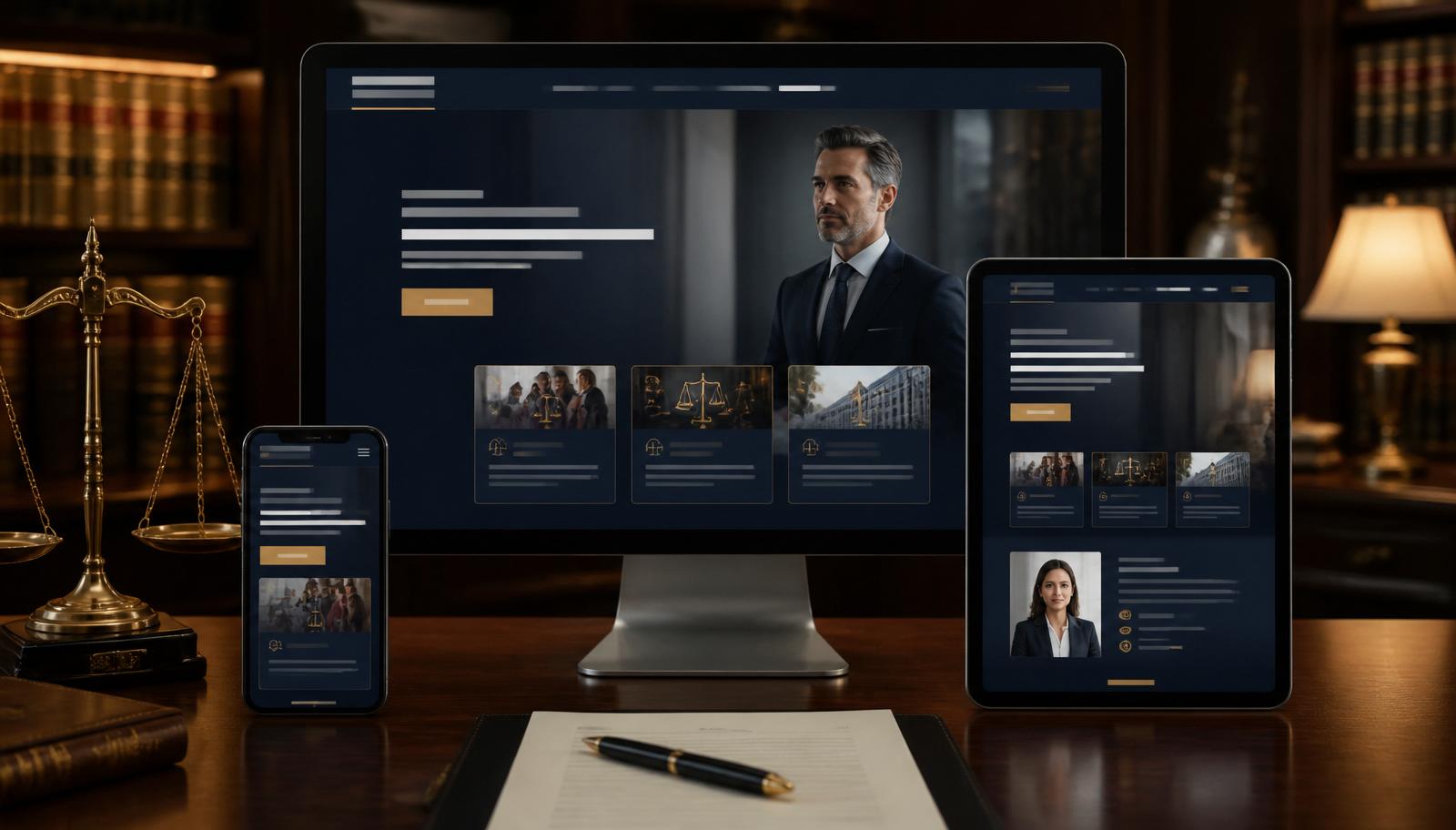
Why law firm web design decides who calls you
Legal services are a high-consideration purchase. Prospective clients research firms across multiple sessions, compare 3–5 websites side by side, and rarely convert on the first visit. A serious attorney website design has to do four jobs in the first ten seconds: signal credibility, communicate practice areas, prove local relevance, and make it obvious how to schedule a consultation.
The best law firm websites treat design as strategy, not decoration. Every hero image, testimonial, and call-to-action is placed to answer one question: *"Can I trust this firm with my case?"*
The pillars of modern legal website design
A great law office website design is built on five pillars — and skipping any one of them costs you leads.
- Clear positioning. The hero states who you serve, what you practice, and what happens next in one glance.
- Practice-area architecture. Each service (personal injury, family, corporate litigation, immigration) gets its own dedicated page, optimized for the searches real clients type.
- Attorney bios that read as authority. Photos, credentials, bar admissions, published cases, and short client stories — not a wall of text.
- Frictionless intake. A visible phone number, a live chat option, and a two-field lead form on every page.
- Speed and accessibility. A site that loads in under 2 seconds on mobile and meets WCAG 2.2 AA is table stakes.
Mobile-first UX and conversion
Most legal traffic in 2026 arrives from a smartphone — often during a stressful moment. A slow, cramped, or hard-to-navigate mobile site is the single largest cause of lost cases.
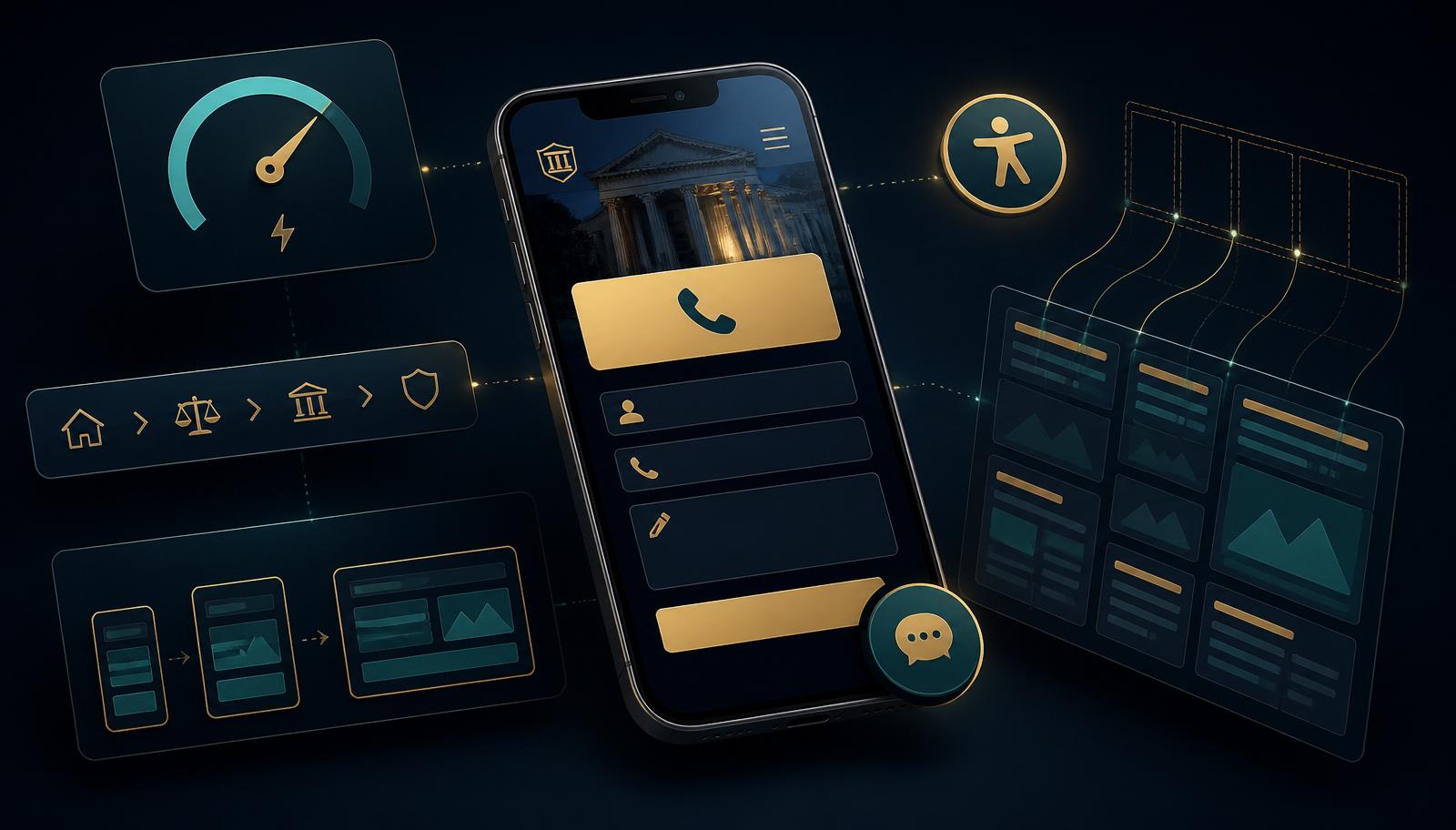
Mobile-first legal web design typically means:
- A sticky tap-to-call button that never leaves the viewport.
- A three-field intake form (name, phone, brief description) above the fold on every practice page.
- Compressed AVIF/WebP images and lazy-loaded video so the site scores 90+ on Core Web Vitals.
- Accessibility-first navigation with proper landmarks, focus states, and screen-reader labels.
Firms that ship these fundamentals typically see intake form completion rates climb from ~2% to 6–9% within a quarter.
Trust signals that convert visitors into clients
Legal buyers are risk-averse. Law firm web design wins or loses on how quickly it establishes credibility. The strongest firm websites layer trust signals throughout the page instead of hiding them on an "About" tab.

High-conversion trust elements include:
- Verifiable credentials. Bar admissions, board certifications, Super Lawyers, Best Lawyers, Martindale-Hubbell ratings.
- Case results with context. Verdict and settlement amounts alongside the practice area and jurisdiction (with the required "prior results" disclaimer).
- Video testimonials. Short, unscripted client stories outperform text quotes by a wide margin.
- Third-party review widgets. Google, Avvo, and Yelp ratings embedded on landing pages.
- Recognizable media logos. "As seen in" strips referencing local news, ABA journals, or industry publications.
Custom vs template law firm websites
One of the most common questions we hear from managing partners is whether to invest in a fully custom law firm website or go with a templated legal theme.
A template legal website is fast and cheap — you can be live in a week for a few thousand dollars. The tradeoff: dozens of competing firms are running the exact same layout, your differentiation collapses, and heavy customization later usually costs more than a custom build would have from day one.
A custom law firm web design takes 8–14 weeks and starts around $15k, but it delivers a distinct brand identity, an information architecture built around your specific practice areas, a component system your team can extend, and Core Web Vitals that outperform templated builds. For firms that treat digital as a real acquisition channel, custom typically pays for itself within the first year.
A reasonable middle ground: start with a well-engineered custom design system, then reuse it across microsites for each practice area or office location.
Local SEO and legal-industry E-E-A-T
The best-designed legal website design in the world will not generate calls if it does not rank. Local SEO is where design meets marketing.
- On-page fundamentals. Unique title, meta description, H1, and schema on every practice-area and location page.
LegalServicestructured data. EmitLegalServiceandAttorneyJSON-LD so Google understands your practice, service area, and reviews.- Location pages. One page per city or metro you serve, with real photos of the office and driving directions.
- Google Business Profile. Fully filled out, weekly posts, and every review responded to within 48 hours.
- Authoritative content. In-depth guides for the questions your ideal client actually types ("do I need a lawyer for…," "how much does X cost in [state]…") — this is the legal-industry version of Google's E-E-A-T signals.
Content strategy for a law firm website
Content is what earns the rankings that design converts. The highest-performing law firm websites publish a mix of:
- Cornerstone practice-area guides (3,000–5,000 words) that fully answer the buyer's question.
- Local landing pages for every jurisdiction you serve.
- Case studies and verdicts with the required disclaimers.
- Short educational blog posts targeting long-tail questions.
- Video FAQs with proper transcripts (great for both accessibility and search).
Pair each piece with clear internal links to your consultation page and you turn your blog into a compounding lead engine.
Compliance, ethics, and disclaimers
Every jurisdiction has bar-association rules about attorney advertising, testimonials, and case results. A professional attorney web design partner will bake these into the design system:
- Standardized "prior results do not guarantee similar outcomes" disclaimers on case-result modules.
- Required "attorney advertising" labels where the state bar requires them.
- Testimonial disclosures where clients are compensated or where actors are used.
- ADA/WCAG conformance to avoid Title III accessibility lawsuits.
- Clear privacy policy, cookie consent, and (where applicable) HIPAA-aligned intake forms for personal injury or medical malpractice practices.
Getting this wrong is expensive. Getting it right, once, in your design system means every future page is compliant by default.
What a modern law firm web design project looks like
A well-run engagement with a specialized law firm web design company typically runs through six phases:
- Discovery — positioning, competitor teardowns, keyword and intake analysis.
- Information architecture — sitemap, practice-area taxonomy, conversion paths.
- UX and wireframes — desktop and mobile flows for hero, practice, attorney, contact, and blog templates.
- Visual design — brand system, typography, photography direction, motion.
- Build — accessible, fast, CMS-driven, with Core Web Vitals tuned before launch.
- Launch and growth — analytics, call tracking, monthly SEO, and quarterly design iterations.
The firms that treat their site as a living product — not a one-time launch — are the ones that dominate their market three years in.
Final thoughts
A great law firm web design is the compounding investment behind every ranking, every call, and every signed retainer. Get the fundamentals right — clear positioning, mobile-first UX, real trust signals, technical SEO, and airtight compliance — and your website stops being a brochure and starts being your best-performing associate.
Work with Devloader
Devloader designs and builds premium law firm websites for boutique practices and multi-office firms across the USA. Our team combines senior product designers, accessibility specialists, and technical SEOs, so your site launches fast, ranks locally, and converts intake at the top of your market.
If you are planning a rebuild, a redesign, or a new microsite for a practice area:
- See our web, mobile and AI engineering services for scope, deliverables, and how we work.
- Review transparent pricing and package options for law-firm-sized engagements.
- Browse the Devloader Marketplace for legal-ready dashboards, admin panels, and intake starter kits.
- Hire vetted senior developers or request a scoped project brief and get a proposal within one business day.
When you are ready to compare us against other agencies on your shortlist, start a conversation — we will send a scoped estimate, references from legal clients, and a technical proposal within 24 hours.
Why Dev Loader LLC
Dev Loader LLC is a USA-registered web engineering studio specializing in high-performance websites for law firms, healthcare practices, and enterprise brands. We pair senior product designers with technical SEOs and accessibility specialists so every law firm site we ship launches fast, ranks locally, and converts intake at the top of its market.
Team highlights
- Senior-only engagements. Every project is staffed with lead designers and engineers with 8+ years of production experience — no juniors billed as seniors.
- Accessibility-first delivery. In-house WCAG 2.2 AA auditors review every template before launch to reduce ADA Title III exposure.
- Technical SEO built in. Structured data (LegalService, Attorney, BreadcrumbList), Core Web Vitals tuning, and local-SEO location pages ship with the build — not as an upsell.
- Compliance-aware design system. Bar-advertising disclaimers, prior-results modules, and privacy-forward intake forms are baked into reusable components.
- Fixed-fee scopes and 24-hour proposals. Transparent pricing, written milestones, and post-launch care plans so partners know what they are signing.
What clients say
"Dev Loader rebuilt our firm's site in ten weeks and our qualified consult requests roughly doubled the quarter after launch. Their intake flow and page speed did the heavy lifting." — *Managing Partner, boutique personal-injury firm*
"The accessibility audit alone was worth the engagement. We went from an obvious ADA risk to a WCAG 2.2 AA-conformant site with proper focus states and screen-reader labels." — *Firm Administrator, multi-office family-law practice*
"Rankings for our top practice-area terms moved into the local pack within four months. The location pages and LegalService schema they shipped are exactly what our old vendor never touched." — *Marketing Director, regional corporate-litigation firm*
Ready to compare us against other agencies on your shortlist? Start a conversation — we will send a scoped estimate, references from legal clients, and a technical proposal within 24 hours.