What Is Next.js? The Ultimate React Framework Guide
Next.js is the React framework for production. Learn what it is, how SSG, SSR, ISR and Edge rendering differ, how it compares to plain React, and when to use it.
If you have spent any time in modern front-end work, you have asked the question: what is Next.js? Next.js is an open-source React framework created and maintained by Vercel. It takes the React library — which only renders user interfaces — and adds the missing production layer: routing, server rendering, static generation, data caching, image optimization, and API endpoints.
So is Next.js a framework? Yes. React is a library; Next.js is the opinionated framework wrapped around it. That distinction is the whole story, and it is what the rest of this guide unpacks.
Key takeaways
- Next.js is a React framework by Vercel that adds routing, rendering, and optimization on top of React.
- React handles UI; Next.js handles the application shell — routes, data fetching, caching, and delivery.
- Four rendering modes (SSG, SSR, ISR, Edge) can be mixed per route segment.
- Server Components cut the JavaScript shipped to the browser, improving INP and TBT.
- Built-in
next/imageandnext/fontmake good Core Web Vitals the default rather than a project. - Choose Next.js when SEO, first-load speed, or full-stack routes matter; plain React is fine behind a login wall.
What is Next.js used for?
Teams reach for Next.js when a plain single-page app stops being enough. In practice, the workloads we see most often are:
- Marketing and content sites that must render fully-formed HTML for crawlers and AI answer engines.
- E-commerce storefronts where every 100 ms of latency has a measurable revenue cost.
- SaaS dashboards that mix public, cacheable marketing routes with authenticated, per-request pages.
- Full-stack products that use Route Handlers and Server Actions instead of running a separate API service.
The common thread is that all of these need server-rendered HTML *and* rich client interactivity in the same codebase. That is precisely the gap Next.js was built to close.
React vs Next.js: the difference that actually matters
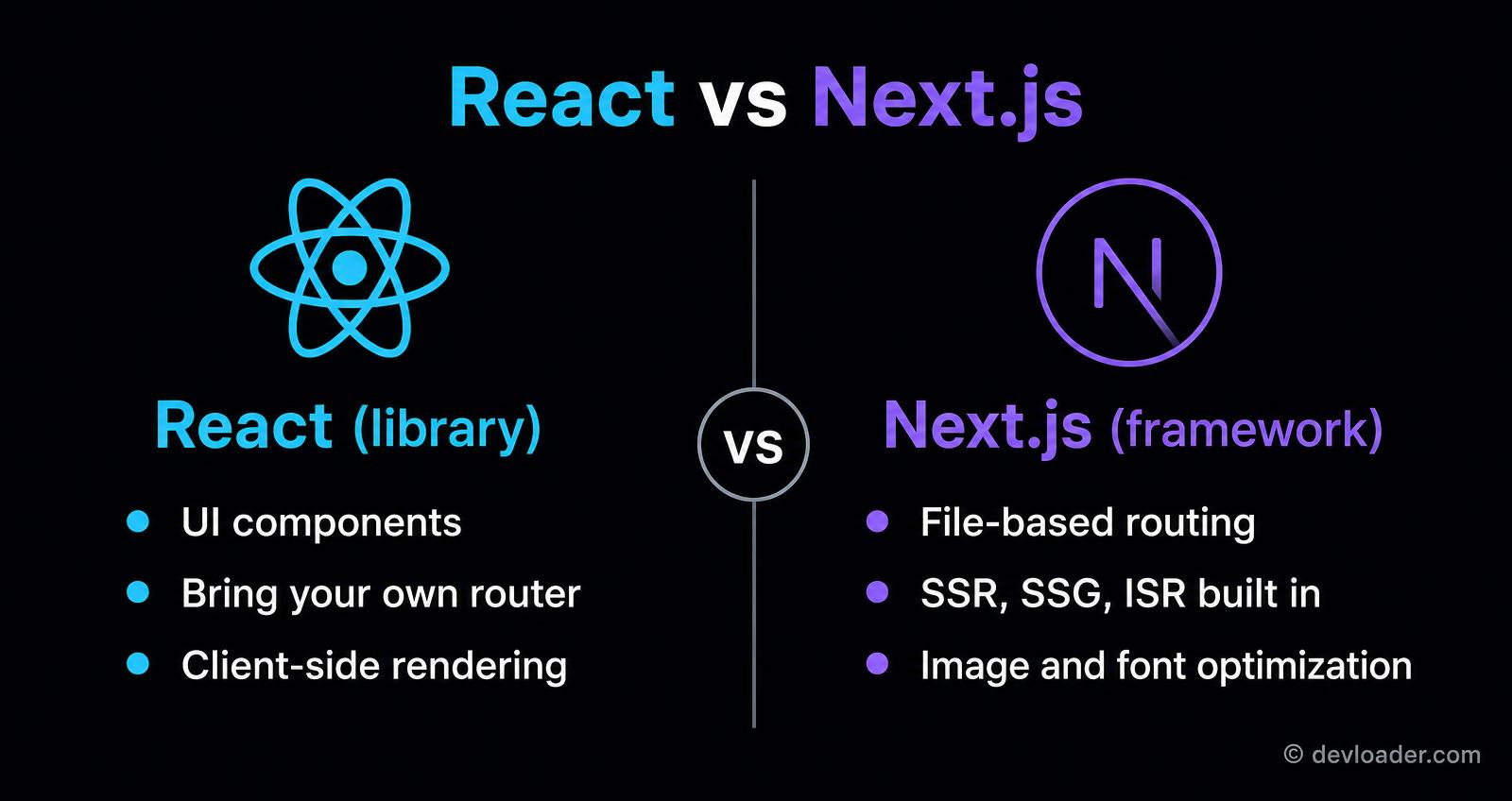
*React gives you components; Next.js gives you the application around them. Diagram © devloader.com*
React is a JavaScript library for building user interfaces. It is excellent at that one job and deliberately silent about everything else — routing, data fetching, bundling strategy, and rendering location are all left to you.
Concern — React (Vite/CRA SPA) — Next.js
Routing — Add React Router yourself — File-system routing in app/
First paint — Blank HTML until JS loads — Server-rendered HTML immediately
Data fetching — useEffect waterfalls — async Server Components
SEO — Needs prerender workarounds — Native SSR/SSG
Images & fonts — Manual pipeline — next/image, next/font
Backend — Separate API service — Route Handlers, Server Actions
The practical impact: a React SPA sends an empty root element and makes the browser download and execute a large bundle before anything is visible. Next.js pre-renders that same page on the server or at build time, so the user — and Googlebot — get real content on the first byte.
If you are weighing this decision for a specific project, our deeper breakdown of React vs Next.js and when to use each walks through the trade-offs with concrete scenarios, and is React still the right framework in 2026 covers the case for staying on plain React.
Next.js rendering strategies explained
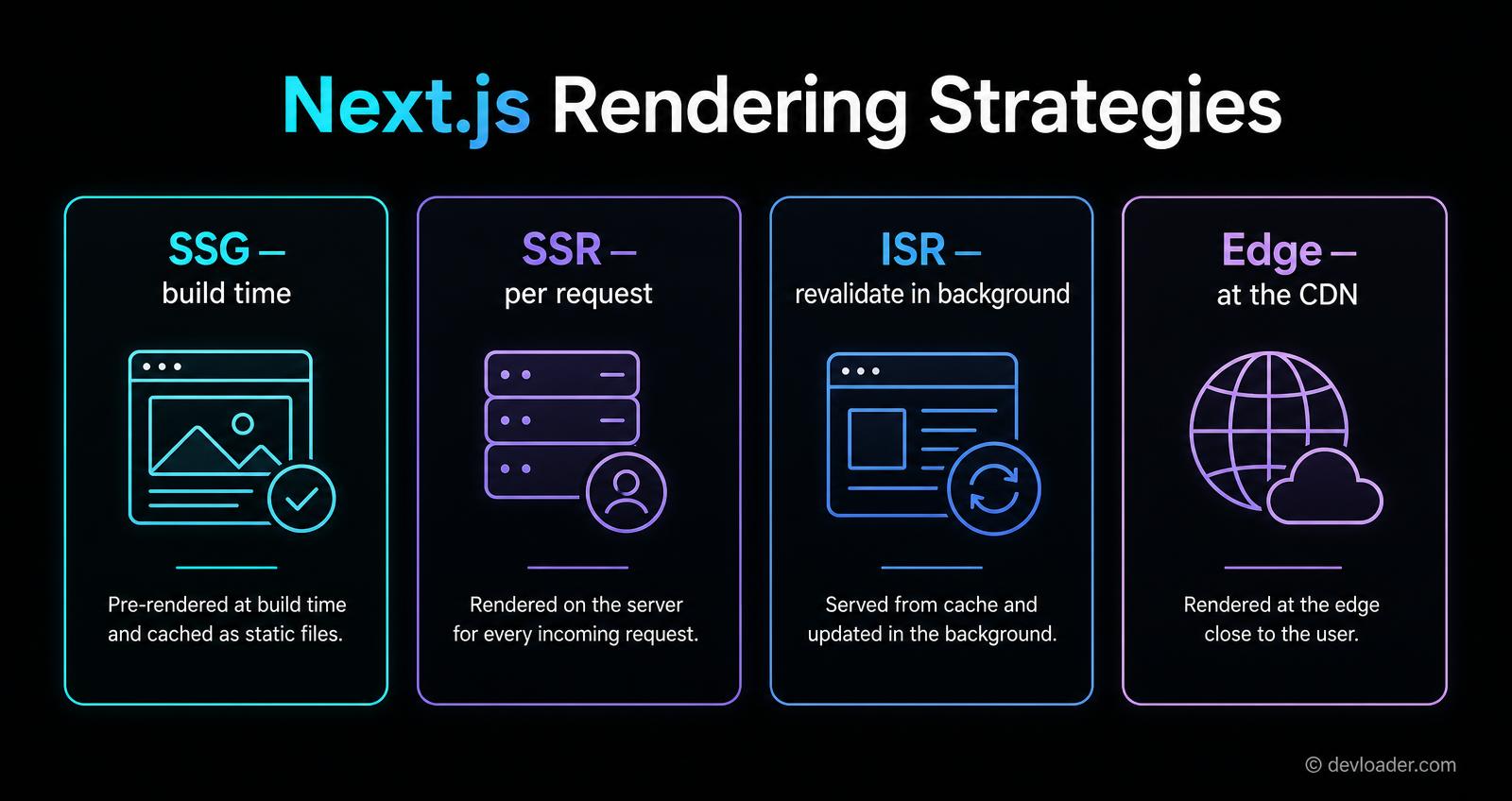
*SSG, SSR, ISR and Edge rendering can be mixed per route segment in the App Router. Diagram © devloader.com*
Static Site Generation (SSG)
Pages are built once at deploy time and served as static files from a CDN. Time to first byte is effectively CDN latency. Use it for docs, pricing, and blog content that changes on a deploy cadence.
Server-Side Rendering (SSR)
HTML is generated per request on the server. This is what makes personalized or fast-changing pages crawlable — the bot receives complete markup instead of an empty shell. The cost is a server round trip on every view, so reserve it for pages that genuinely differ per user or per minute.
Incremental Static Regeneration (ISR)
ISR is the middle ground: serve the cached static page instantly, then regenerate it in the background after a revalidate window or an on-demand webhook. A 5,000-page catalogue can stay fresh without a 40-minute full rebuild.
// app/products/[slug]/page.tsx
export const revalidate = 3600; // regenerate at most once an hour

export default async function ProductPage({ params }: { params: { slug: string } }) {
  const product = await getProduct(params.slug);
  return <ProductView product={product} />;
}
Edge rendering
Middleware and edge routes run on CDN nodes close to the user — ideal for auth checks, geo redirects, and A/B assignment, where a round trip to a single origin region would be felt.
Server Components vs Client Components
The App Router's biggest shift is that every component is a Server Component by default. It runs on the server, can await data directly, and ships zero JavaScript to the browser. You opt into interactivity file by file:
'use client';

import { useState } from 'react';

export function Counter() {
  const [n, setN] = useState(0);
  return <button onClick={() => setN(n + 1)}>Clicked {n}</button>;
}
The discipline is simple: keep data fetching and layout on the server, push 'use client' as far down the tree as possible. Teams that do this routinely cut their client bundle by 30–60%, which shows up directly in Interaction to Next Paint.
Performance and deployment
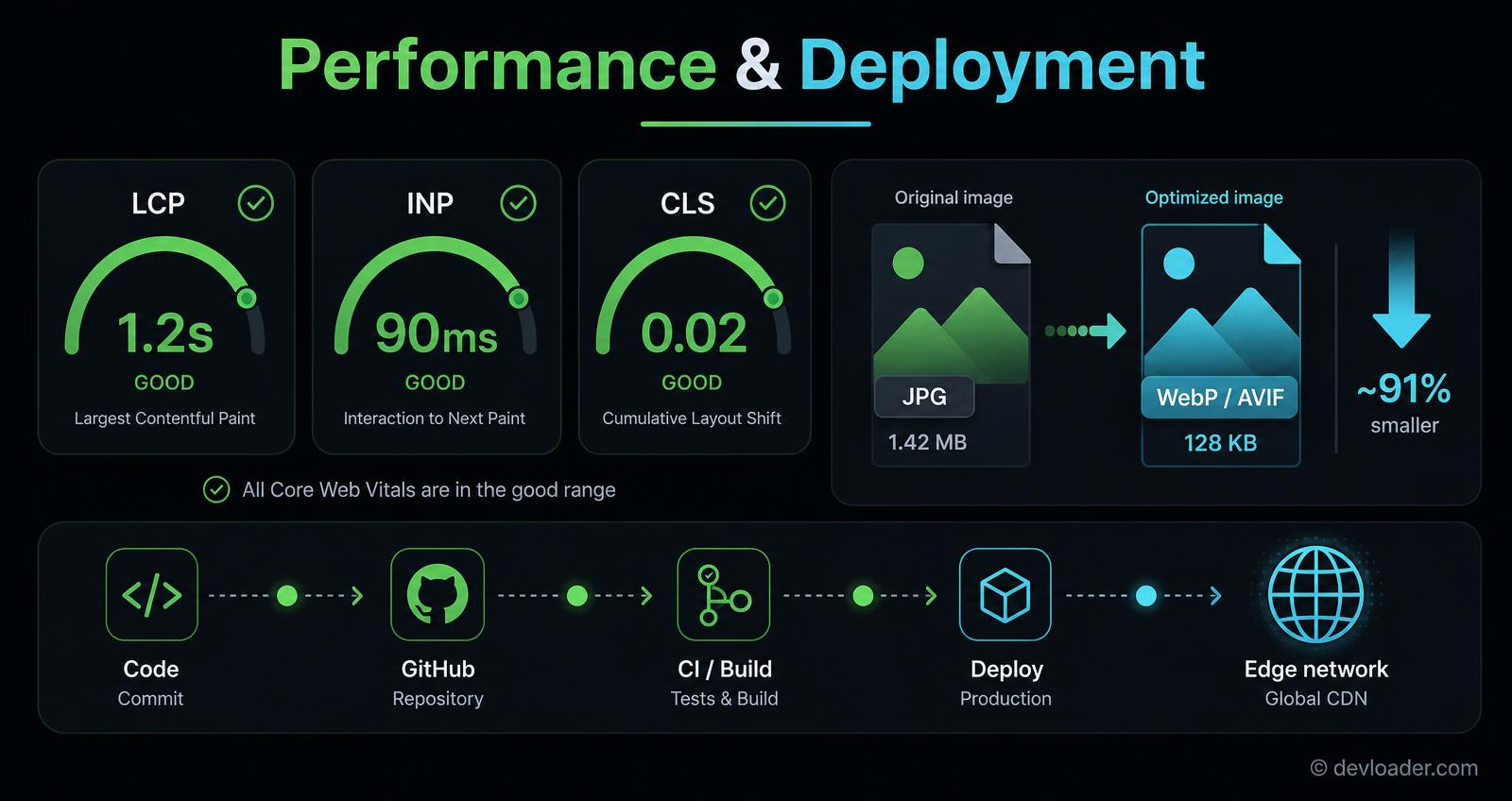
*Automatic image optimization and edge delivery keep LCP, INP and CLS in the green. Diagram © devloader.com*
next/image resizes, converts to WebP or AVIF, and lazy-loads below-the-fold images while reserving layout space — which removes the two most common Core Web Vitals failures at once (oversized LCP images and layout shift). next/font self-hosts web fonts with size-adjust metrics so text does not jump on load.
For deployment, Next.js runs anywhere Node.js runs — a container, a VPS, or a managed platform. Vercel is the first-party option and gives you per-pull-request preview URLs, global edge distribution, and serverless functions with no infrastructure work. Self-hosting with output: 'standalone' in Docker is a fully supported path when you need control.
If you are shipping a Next.js site and want it to actually rank, our Next.js 15 App Router SEO guide covers the metadata API, generateMetadata, and sitemap conventions in detail.
Common pitfalls and how to fix them
- Pitfall: Marking whole pages
'use client'out of habit. Fix: Keep pages as Server Components and isolate hooks in small leaf components. - Pitfall: Fetching in
useEffectand losing SSR benefits. Fix: Await data in the Server Component instead. - Pitfall: Using a raw image tag instead of
next/image. Fix: Migrate and always setwidth/heightorfill. - Pitfall: Stale data after a mutation. Fix: Call
revalidatePathorrevalidateTagin the Server Action. - Pitfall: Leaking secrets into the client. Fix: Only
NEXT_PUBLIC_*variables reach the browser — keep everything else server-side.
When Next.js is not the right answer
Next.js is not automatically correct. An internal tool behind a login has no SEO requirement and may be simpler as a Vite SPA. A purely static brochure site with no dynamic data may be better served by a lighter static generator. And if your team is deep in PHP, the calculus changes — we compared both stacks in Laravel vs Next.js.
FAQ
Is Next.js a framework or a library?
Next.js is a framework. React is the underlying library that renders the UI; Next.js supplies the routing, rendering, caching, and build tooling around it, and defines the project structure you work within.
Is Next.js better than React?
The question is slightly off. Next.js is React, plus a production layer. It is better when you need SEO, fast first paint, or server-side logic. Plain React remains a fine choice for authenticated dashboards where none of that applies.
Do I need to know React before learning Next.js?
Yes. Components, props, state, and hooks are prerequisites. Next.js concepts — the App Router, Server Components, caching — sit on top of that foundation.
What is the difference between the App Router and the Pages Router?
The App Router (app/) is the current default and where new features ship: Server Components, streaming, layouts, and the metadata API. The Pages Router (pages/) is still supported and both can run in one project during a migration.
Is Next.js good for SEO?
It is one of the strongest options available. Server rendering and static generation deliver complete HTML to crawlers, and the built-in metadata API handles titles, descriptions, canonicals, Open Graph tags, and sitemaps without extra libraries.
Can I use Next.js without Vercel?
Yes. Next.js runs on any Node.js host, in Docker with output: 'standalone', or on other managed platforms. Vercel offers the tightest integration for features like ISR and image optimization, but it is not a requirement.
How long does it take to migrate a React SPA to Next.js?
For a typical 20–40 route SPA, expect two to four weeks: route mapping, converting data fetching to Server Components, moving auth to middleware, and rewriting the build pipeline. Incremental migration route by route is the lower-risk approach.
Related content
- React vs Next.js: which should you use? — a decision framework for choosing between the library and the framework.
- Next.js 15 App Router SEO guide — metadata, sitemaps, and structured data for App Router projects.
- Laravel vs Next.js in 2026 — full-stack PHP versus a React-first architecture.
- How to hire Next.js developers — what to screen for when building a Next.js team.
- Next.js admin dashboard templates — reviewed starters for internal tools.
Build your Next.js project with Dev Loader
We build and migrate production Next.js applications — App Router architecture, Server Component refactors, Core Web Vitals remediation, and SEO-complete implementations with structured data and sitemaps built in from day one.
If you are planning a new Next.js build or moving an existing React SPA across, tell us about your project and you will get a scoped proposal — team profiles, timeline, and a fixed quote — within 48 hours. You can also browse our web application development service or see recent work.
About the author
Dev Loader Editorial is the in-house engineering and content team at Dev Loader LLC, a software development company headquartered in Washington, DC. Our engineers ship React and Next.js applications in production — App Router migrations, e-commerce storefronts, and SaaS platforms — and this guide reflects patterns we apply on live client work, not theory. Editorial standards, sourcing, and correction policy are published in our editorial policy.