Benefits of Implementing Agile in Teams
Explore the real-world benefits of implementing agile in teams — faster delivery, stronger collaboration, higher quality, and a 5-step transformation roadmap that works for small and enterprise teams.
Adopting agile is not just a process change — it is a shift in how a team thinks about work, collaborates, and delivers value. Done well, the benefits of implementing agile in teams compound quickly: faster delivery, higher quality, happier people, and a product that actually matches what customers want. At Dev Loader LLC we've rolled out agile practices with startups, growing SaaS companies, and enterprise product groups, and the pattern is consistent — the teams that commit see measurable results within a single quarter.

Why agile matters for modern teams
Traditional project management assumes you can define everything up front, then execute against a fixed plan. That assumption breaks the moment a customer changes their mind, a competitor ships a new feature, or your own team learns something new mid-build. Agile inverts the model: you plan a little, ship a little, learn a lot, and adjust — every two weeks, forever.
That rhythm is what makes agile a strategic advantage rather than a productivity gimmick. It is also why the same practices that transformed web application development services now show up in marketing, HR, and finance teams.
The 8 biggest benefits of implementing agile in teams
1. Faster delivery of value
Agile teams ship in short sprints — usually two weeks — instead of waiting months for a big-bang release. Every sprint produces a working slice of the product that a real customer can use. Time-to-value drops from quarters to weeks, and the team can course-correct as soon as feedback comes in. Our custom web development engagements almost always ship a public MVP within the first eight weeks of a project.
2. Stronger cross-functional collaboration
Agile teams are small, cross-functional, and co-located (physically or virtually). Designers, engineers, QA, and product sit together and solve problems in real time instead of throwing documents over a wall. That single change eliminates the biggest source of waste in most organizations — the handoff. Great UI/UX work especially benefits, because designers see how their decisions play out in code within the same sprint.
3. Higher product quality
Because testing is built into every sprint — not deferred to a QA phase at the end — bugs get caught within hours instead of weeks. Definition of Done, continuous integration, code reviews, and demo-driven sprints all compound. Teams practicing disciplined agile typically see their change failure rate drop by more than half within the first year.
4. Better adaptability to change
Requirements change. In waterfall that's a crisis; in agile it's just the next backlog refinement. Because the plan is only committed one sprint at a time, the team can absorb new priorities, drop obsolete work, or pivot entirely without derailing the project. This adaptability is exactly what makes agile the default for competitive mobile app and product teams.

5. Increased transparency for stakeholders
Sprint reviews, public burndown charts, and a shared backlog give stakeholders a real-time view of progress — no more status-report theater. Executives can see exactly what shipped last sprint, what's shipping next, and what's blocked. That transparency dramatically reduces the "why isn't this done yet?" tension that kills so many traditional projects.
6. Higher employee engagement and retention
Agile shifts decision-making to the people closest to the work. Developers help scope stories, choose the technical approach, and set their own daily plan. Retrospectives give the team a real voice in fixing process pain. Autonomy, mastery, and purpose are the classic drivers of intrinsic motivation — and a well-run agile team delivers all three. Engagement scores measurably improve, and top performers stay longer.
7. Reduced risk and lower cost of failure
Because agile releases early and often, failures happen small and cheap instead of large and catastrophic. A misjudged feature is caught after one sprint's worth of investment, not after nine months of build. Financial risk drops with it: many of our clients recoup their entire engineering spend inside 12 months because they stopped funding features nobody wanted.
8. Continuous improvement built into the process
Every sprint ends with a retrospective — a short meeting where the team asks "what worked, what didn't, what will we change next sprint?" That single ritual is why agile teams keep getting better over time while traditional teams plateau. Small improvements compound into a fundamentally healthier delivery culture.
Agile transformation roadmap for teams
Adopting agile is a rollout, not a switch. Here is the five-step roadmap we use for Dev Loader consulting engagements:
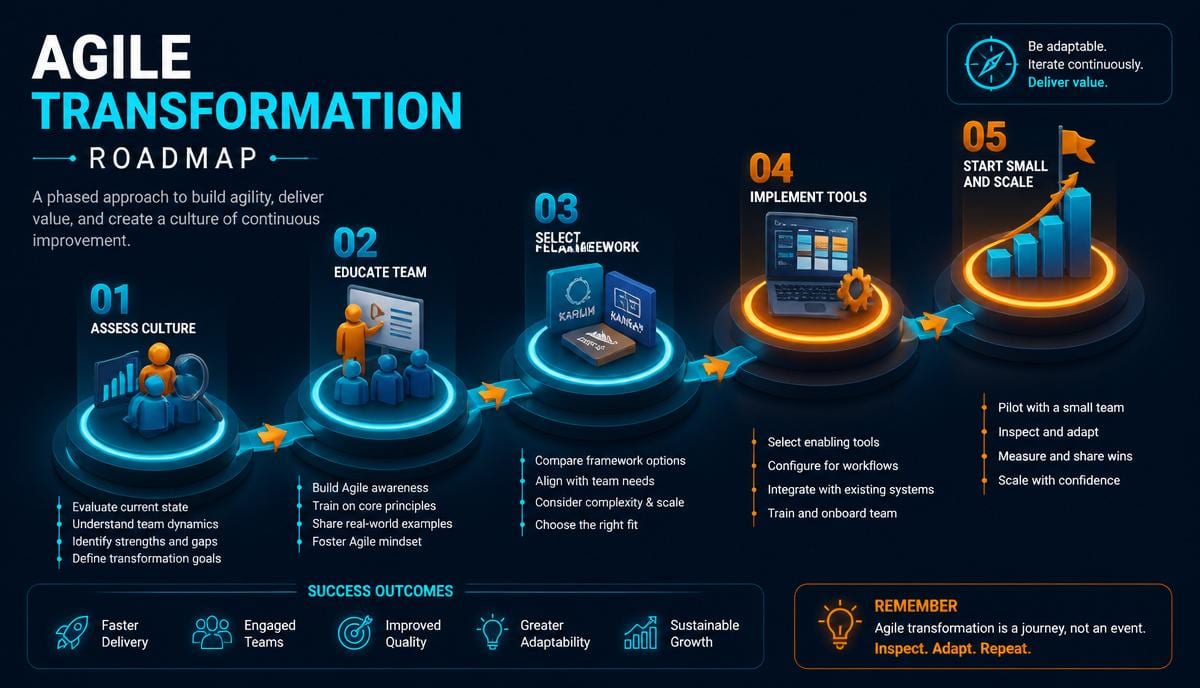
- Assess culture. Map current pain points, identify champions, and secure leadership sponsorship. Skip this step and even the best framework fails.
- Educate the team. Train everyone — including leadership — on the Agile Manifesto, Scrum or Kanban basics, and the mindset shifts required.
- Select a framework. Scrum for product teams, Kanban for continuous flow (support, ops), a hybrid for most modern organizations. Match the framework to the work.
- Implement tools. A shared board (Jira, Linear, GitHub Projects), a lightweight CI/CD pipeline, and a demo cadence. Resist over-tooling on day one.
- Start small and scale. Pilot with one team for two to three sprints, publish the wins internally, then let other teams volunteer. Only layer on a scaling framework (SAFe, LeSS) once several teams are stable.
Common challenges (and how to avoid them)
- Leadership treats it as tooling. Agile is a culture change; buying Jira and calling it "agile" fails every time.
- Keeping the old project-manager role. The Product Owner and Scrum Master roles distribute that responsibility — respect the split.
- Skipping retrospectives. The moment you drop the retro, continuous improvement stops.
- Measuring on velocity instead of outcomes. Story points are a planning tool, not a performance metric.
- Ceremonies designed for a shared room. Distributed teams need asynchronous rituals, not video-conference re-runs of in-person meetings.
Measuring the benefits: what to track
Use a short, honest scorecard so you can actually see the benefits show up:
- Deployment frequency — how often you ship to production.
- Lead time for changes — commit to production in hours, not weeks.
- Change failure rate — percentage of deploys that cause an incident.
- Sprint goal met (yes/no) — a binary signal you cannot game.
- Team health score — one monthly qualitative check.
These map directly to the DORA metrics used by high-performing engineering organizations, and they give leadership a real signal of the agile ROI.
When agile is (and isn't) the right choice
Agile shines when requirements are uncertain, feedback loops matter, and the team is empowered to make decisions. It is the wrong tool when scope is truly fixed (a regulated infrastructure build with a legally locked spec, for example), or when the organization refuses to shift decision-making to the team. Read our complete agile methodology guide for a deeper decision framework.
Work with Dev Loader on your agile transformation
At Dev Loader LLC we don't just talk about agile — we build with it every day across responsive web design, custom web application development, UI/UX design, and native mobile apps. If you're rolling out agile in your team, or you want a delivery partner who ships in tight, transparent sprints from day one, our team is ready to help. Book a free discovery call and we'll map your first 90-day agile roadmap — no obligation, no sales pressure.
Final thoughts
The benefits of implementing agile in teams are not theoretical. They show up in shorter release cycles, higher-quality software, engaged people, and customers who feel heard. Start with one team, run it well for three months, and let the results build your case for scaling further. That is how every successful agile transformation begins — and how Dev Loader helps our clients ship better products, faster.