SaaS Billing Strategies: The 2026 Founder's Playbook
The billing playbook we use with SaaS clients — pricing models, Stripe vs Paddle, dunning, tax, refunds, and the metrics that predict revenue.
SaaS Billing Strategies: The 2026 Founder's Playbook
 *Above: the kind of unified billing dashboard we ship with every Dev Loader SaaS engagement — MRR, churn, dunning recovery, and Stripe/Paddle invoices in one place. © devloader.com*
Billing is the operating system of a SaaS company. It decides which customers you attract, how much they'll pay, whether they'll stay, and how much of your revenue actually reaches the bank. Get billing right and pricing changes ship in a week. Get it wrong and every quote, invoice, and dunning email turns into a support ticket.
This guide is the exact playbook we walk our clients through when we design a SaaS billing stack — the pricing models that survive contact with real customers, the tax and compliance calls that get founders in trouble, and the exact edge cases that quietly leak 5–15% of ARR.
1. Pick a pricing model that scales with value
Every durable SaaS business tracks a single "value metric" — the unit that scales alongside a customer's success. When your billing meter matches that metric, revenue grows with the customer instead of forcing them to negotiate.
Per-seat works when collaboration is the product (Notion, Linear, Figma). It's simple to explain and stable to forecast, but caps at team size. Add seat tiers to avoid the trap where a 20-person team pays the same as a 200-person team.
Usage-based aligns price with impact — API calls, GB stored, minutes transcribed. It's what OpenAI, Twilio, and Cloudflare Workers use. The upside is that small customers pay small bills and stay; the downside is unpredictable invoices, which enterprise buyers hate. Publish a real-time meter and pre-purchase credits to fix it.
Hybrid (platform fee + usage) is what most 2026 SaaS billing stacks look like: a base subscription for the seat/platform and metered add-ons for consumption. Vercel, Supabase, and Segment all use variants of this.
Outcome-based ties price to a delivered result — leads generated, revenue processed, tickets resolved. It's the hardest to instrument and the easiest to sell, because the customer is buying an outcome, not software.
Whichever you pick, write down the value metric and revisit it every six months. If sales keeps giving discounts on one line item and never on another, that line item is misaligned.
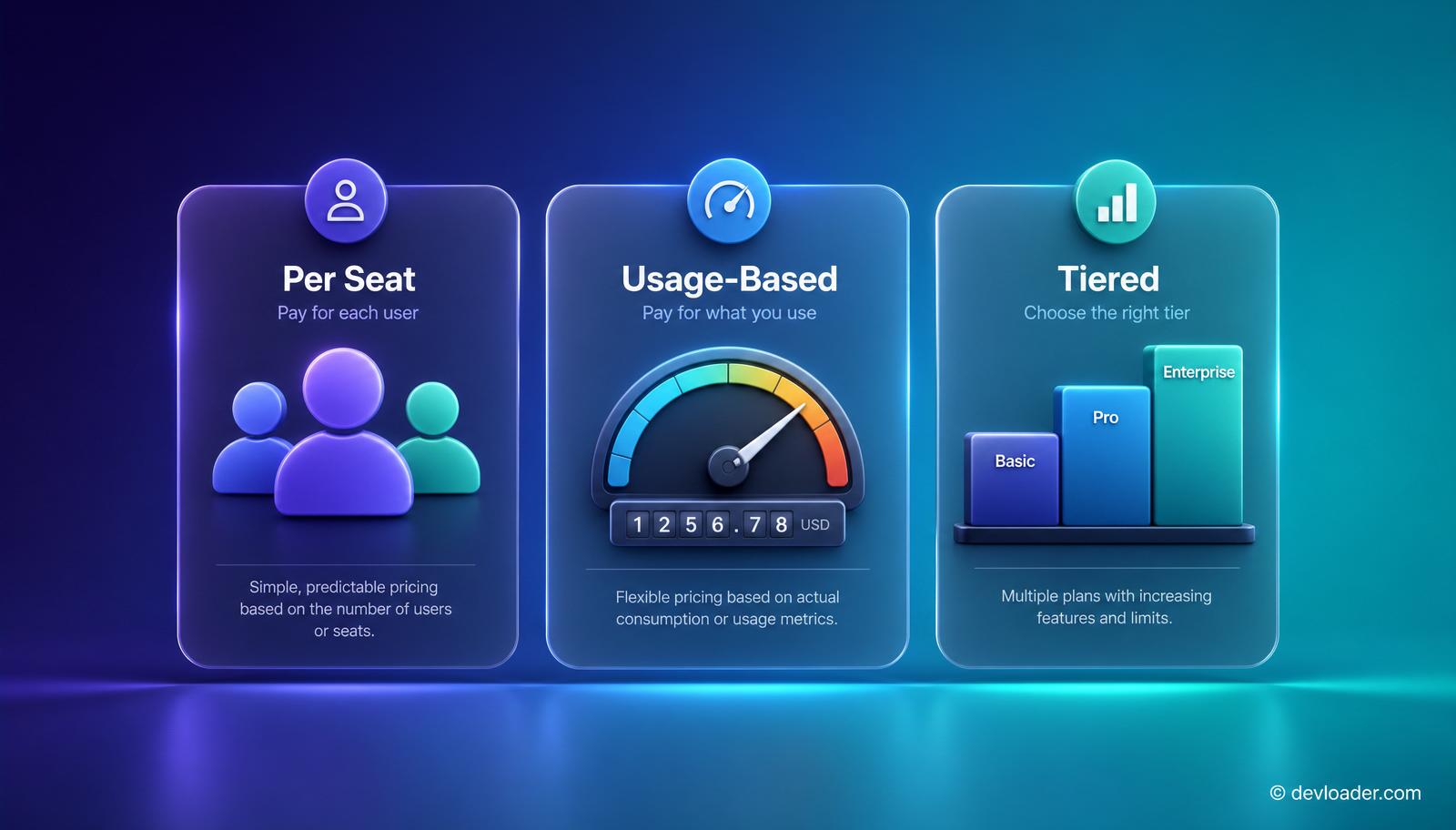 *The three SaaS pricing models we benchmark for every client — per-seat, usage-based, and tiered. © devloader.com*
2. Build a tier ladder that funnels toward the right plan
Three tiers is the default for a reason: buyers compare a middle option against a cheaper and a pricier neighbor. Skip the free tier if you sell to businesses — it attracts unqualified traffic and inflates support cost. Use a 14-day trial with a credit card instead; conversion is roughly 3× a no-card free trial in most B2B SaaS categories.
Anchor the top tier at 3–5× the middle tier. Its job isn't to sell — it's to make the middle tier look like a bargain. Include one obvious enterprise feature (SSO, audit logs, custom SLAs) that self-serve buyers don't need, so procurement teams have a clear reason to upgrade.
Publish prices. "Contact us" pricing pushes most founder-led buyers to a competitor with a public price page, and it wrecks your organic search coverage — you won't rank for "<product> pricing" without a real page.
3. Choose a billing engine you won't outgrow in 12 months
There are four realistic options in 2026:
- Stripe Billing — the default. Fastest to integrate, cleanest developer experience, best docs. Weak on tax outside the US and on complex invoicing (net-30, POs, multi-entity). Merchant of Record (MoR) only if you enable Stripe Tax and file everywhere yourself.
- Paddle — Merchant of Record built in. Paddle handles global VAT, GST, and sales tax; you get one payout, one 1099. Fees are higher (~5% + fixed) and you have less control over the checkout. Ideal for founders in the EU, UK, or anywhere the tax matrix is scary.
- Lemon Squeezy — MoR like Paddle, aimed at indie SaaS. Simplest onboarding, weakest for enterprise deals and metered billing.
- Chargebee / Recurly / Maxio — subscription management on top of Stripe/Adyen. Worth it once you sell above $2k ACV, have a sales team, or need dunning workflows that Stripe alone can't handle.
If you don't know the answer, start on Stripe Billing, add Stripe Tax for the US, and move to Paddle only when EU/UK VAT starts hurting. We've written a longer comparison in Stripe vs Paddle for SaaS if you want the tradeoffs in depth.
4. Prorate everything, upgrade instantly, downgrade at renewal
Two rules cut most billing support tickets in half:
- Upgrades apply immediately, prorated to the second. The customer gets the new features today and a prorated line item on the next invoice. This is what Stripe and Paddle do by default — don't fight it.
- Downgrades schedule for the next renewal. Never refund the current period. This prevents an entire class of abuse (upgrade for a feature, use it, downgrade the next day) and matches the mental model buyers already have.
For seat adds mid-cycle, invoice the delta the same day. For seat removals, credit them at renewal. Never issue a cash refund unless it's a service failure — issue account credit instead. Credit is 80% cheaper to process and roughly doubles the odds the customer stays.
5. Instrument tax and compliance before your first international sale
The moment you sell across borders, you inherit tax obligations. In the US, economic nexus kicks in around $100k or 200 transactions per state; every state has its own threshold and cadence. In the EU, VAT applies from the first euro if you're selling to consumers (B2C); B2B uses reverse charge if you collect a valid VAT ID.
Three ways to handle it:
- Merchant of Record (Paddle, Lemon Squeezy, Polar). They become the seller of record, file taxes globally, and pay you net. Simplest legally, most expensive per transaction.
- Automated tax on your own MID (Stripe Tax, Anrok, TaxJar). You stay the seller, they calculate and file. Cheaper per transaction, but you're on the hook for registration in every jurisdiction.
- Manual filing. Only viable if you sell in one or two jurisdictions.
Whichever you pick, keep a "tax posture" document — a one-pager listing where you're registered, what threshold you'll hit next, and who owns the filing. Founders lose weeks re-deriving this every time an accountant asks.
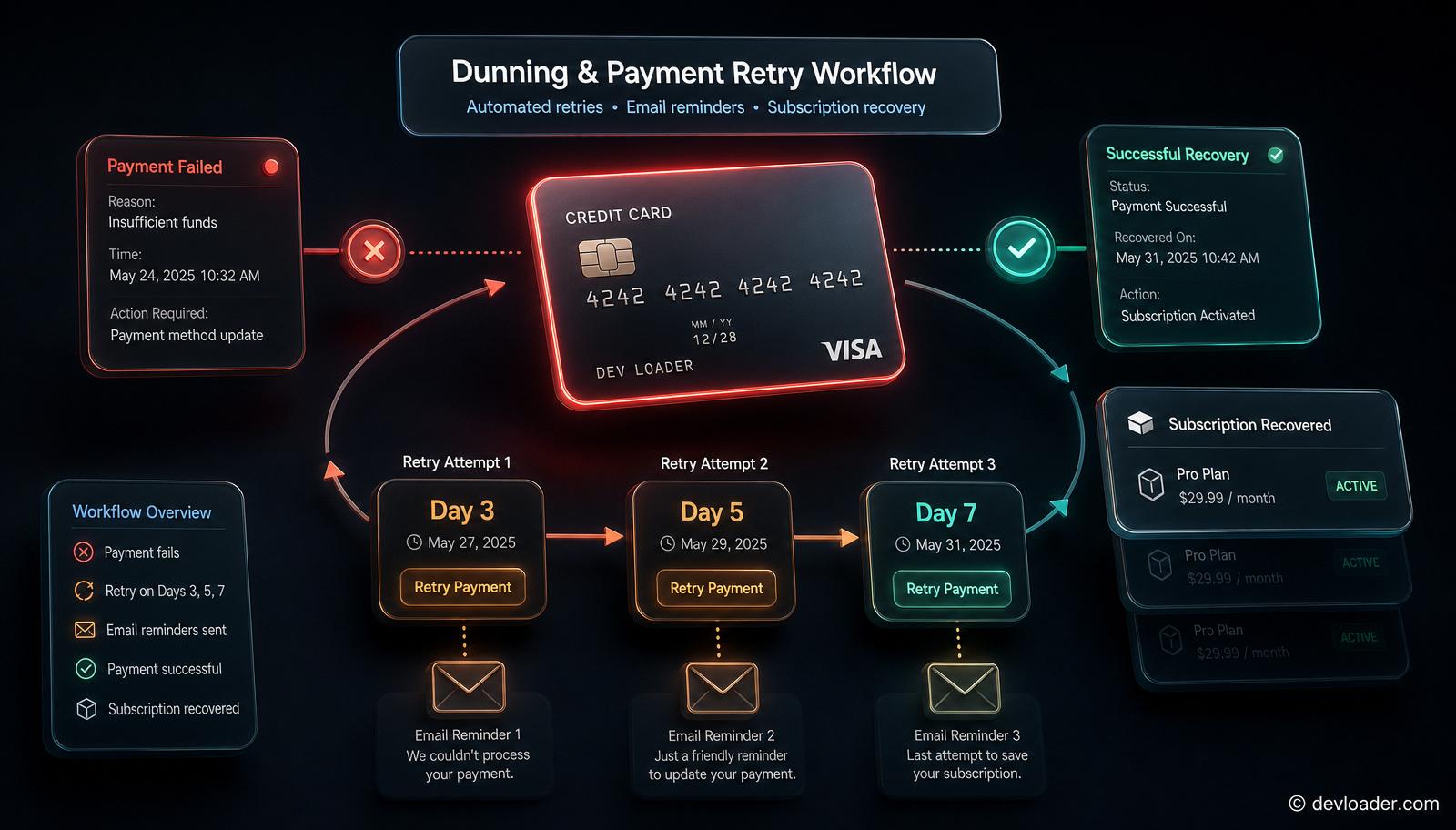 *A Stripe Smart Retries dunning flow — retries on days 3, 5, and 7 with three transactional emails and a one-click card-update link. © devloader.com*
6. Design dunning like a product feature
Involuntary churn — failed cards, expired cards, insufficient funds — is 20–40% of total churn for most SaaS companies. It's also the easiest churn to recover, because the customer wanted to stay.
A dunning sequence that actually works:
- Day 0: Silent retry. Stripe's Smart Retries and Paddle's Recover both handle this — leave them on.
- Day 1: Email the billing contact with a one-click update-card link. Never mention "suspension" yet.
- Day 3: Second email. Add a support address. Retry the card.
- Day 7: Third email plus an in-app banner. Warn that access will be limited.
- Day 14: Downgrade to a read-only state. Keep the data.
- Day 30: Cancel. Send an offboarding email with an export link and a re-activation offer.
Never hard-delete on day 30. Roughly 15% of "cancelled" customers reactivate within 90 days if the account is still recoverable.
7. Handle refunds, credits, and disputes with a written policy
Publish a refund policy — even a strict one — and put a link in every invoice and receipt. Chargebacks drop measurably when the policy is visible before purchase.
For annual plans, offer a pro-rata refund for the unused months minus any granted discount. For monthly plans, refund only the current period on service failure. For disputes, respond within Stripe/Paddle's 7-day window with (a) the signed terms, (b) the login timestamps, and (c) the actual product usage. Response rate matters more than length.
8. Track the metrics that predict, not the ones that describe
Most SaaS billing dashboards show MRR, ARR, churn — describe metrics. Predict metrics are more useful for pricing decisions:
- Net Revenue Retention (NRR). Above 110% means your expansion covers churn; below 90% means the model is leaking.
- Gross margin per plan. If your entry tier has negative gross margin after Stripe fees, support cost, and infra cost, kill it.
- Time-to-payback per acquisition channel. Channels that pay back in under 12 months can scale. Channels above 24 months cannot.
- Failed payment recovery rate. Anything below 60% means your dunning sequence needs work.
- Discount velocity. If sales grants a discount on more than 30% of deals in a quarter, list prices are wrong.
Build these into a weekly digest emailed to the founding team.
9. The compliance layer nobody talks about until they need it
- PCI DSS. If you never touch a card number (Stripe Elements, Paddle Checkout, Lemon Squeezy hosted), you're SAQ A — a one-page self-assessment. Don't build a custom card form unless you have a compliance officer.
- SOC 2. Not a billing feature per se, but enterprise buyers will ask for it. Vanta or Drata get you audit-ready in 3–6 months.
- GDPR / UK GDPR. Every invoice and receipt is personal data. Store them behind the customer's authenticated session, honor deletion requests, and keep a data processing agreement (DPA) template ready.
- 1099-K / income reporting. Merchant processors will report your gross to the IRS from the first dollar in most states. Don't wait to reconcile.
10. What we'd build today for a new SaaS
If we were shipping a new SaaS billing stack this week:
- Stripe Billing + Stripe Tax for the US, or Paddle if the founders live in the EU/UK.
- Metered usage via Stripe's usage-based subscriptions, aggregated hourly.
- Customer Portal enabled on day one so customers self-serve plan changes, invoices, and card updates.
- Webhooks handled by a single edge function that writes every event into a
billing_eventstable before triggering side effects. This single change prevents 90% of "the invoice says X but the DB says Y" bugs. - Dunning through Stripe Smart Retries + one custom email flow for enterprise accounts over $2k MRR (they need a human touch).
- Weekly digest to the founders covering NRR, dunning recovery, discount velocity, and top 10 expansion accounts.
That stack costs less than a week to wire up, scales to $10M ARR without a re-platform, and gives you the instrumentation to make pricing decisions with real numbers.
Frequently asked questions
Should I start with usage-based or per-seat pricing? Per-seat if collaboration is the product. Usage-based if consumption varies wildly between customers. Hybrid if you can't decide — most successful SaaS lands here eventually.
When do I need a Merchant of Record? When international sales exceed 20% of revenue, or when EU VAT filings start eating a week per quarter. Below that, Stripe + Stripe Tax is cheaper and gives you more control.
How do I raise prices without churning existing customers? Grandfather everyone on current pricing for 12 months, announce the change 90 days in advance, and offer a one-time annual pre-pay at the old rate. Expect ~5% voluntary churn and 2–3× that in expansion from customers moving to annual.
What's the single biggest billing mistake founders make? Not persisting webhook events. When Stripe retries a webhook and your handler is idempotent, everything works. When it isn't, you'll spend a weekend reconciling invoices. Write every event to a table before you act on it.
Do I need a custom billing UI? No. Stripe Customer Portal and Paddle's hosted management pages cover 95% of what customers ask for. Build custom only after you've measured what portal features get used.
Related content from Dev Loader
Keep going deeper into the SaaS billing stack — every guide below is written by the same team that ships production billing integrations for our clients:
- Consumer fintech pricing in practice — see how cash advance apps like Dave monetise without interest using tips, express fees and subscriptions.
- Stripe vs Paddle for SaaS — read our full Stripe vs Paddle comparison for SaaS founders to decide between direct Stripe integration and a Merchant-of-Record model.
- Ship subscriptions in a week — grab our Stripe subscription starter kit for SaaS with webhooks, customer portal, and idempotent event storage baked in.
- From idea to launch — the step-by-step SaaS MVP launch playbook for 2026 covers billing, auth, and hosting decisions in the right order.
- Backend under the billing layer — see why we default to Supabase over Firebase for SaaS founders when Postgres, RLS, and auditable billing events matter.
- Rails/Laravel teams — the Laravel SaaS boilerplate for 2026 ships Cashier + Paddle + team billing out of the box.
About the author & Dev Loader
This playbook is written by the Dev Loader engineering team — a US-based software studio (Dev Loader LLC, 236 Farragut St NW H203, Washington, DC 20011) that has shipped Stripe, Paddle, Lemon Squeezy, and custom metered-billing integrations for SaaS founders across fintech, devtools, healthtech, and B2B collaboration since 2019. Our senior engineers have wired billing stacks that today process eight-figure ARR, and every recommendation in this guide comes from production incidents we have fixed — not from marketing pages.
Credentials & trust signals
- 100+ SaaS billing integrations delivered end-to-end (Stripe, Paddle, Lemon Squeezy, Fastspring, custom).
- Stripe-certified partner engineers on staff; SOC 2 Type II hosting posture with Vanta.
- GDPR-compliant DPAs and PCI DSS SAQ-A architectures on every engagement.
- Featured in client case studies covering usage-based metering at scale, EU VAT compliance, and dunning-recovery tuning.
- Trusted by founders from YC, Techstars, and self-funded bootstrappers alike.
Need help wiring this into your product? We ship billing integrations end-to-end — Stripe, Paddle, custom metering, dunning, and the analytics layer on top. Get a quote and we'll scope it in a week.