AI Governance Responsibilities: Frameworks & Compliance
Discover the core AI governance responsibilities essential for securing innovation while ensuring ethical and legal compliance in your organization.
When an AI system denies a loan, filters a résumé, or publishes a marketing campaign under your brand, the accountability does not sit with the model. It sits with the people who deployed it. That is why formalising AI governance responsibilities has moved from a compliance nicety to a board-level requirement.
A workable governance strategy does not slow innovation down — it makes innovation defensible. Done properly, it lets teams ship intelligent systems quickly while keeping ethics, security, and regulatory exposure under control.
What we learned implementing AI governance with clients
We help product and compliance teams put governance around live AI features, and the same three patterns repeat.
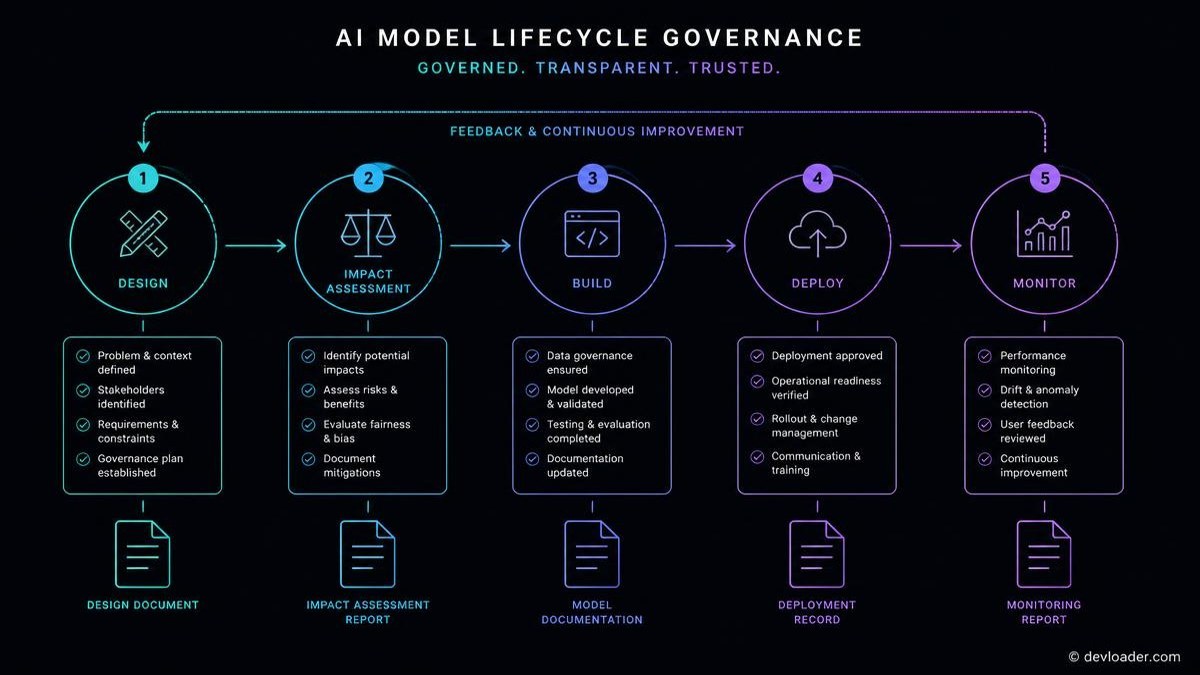
First, governance fails when it lives in a policy document instead of the delivery pipeline. The programmes that work attach a required artefact to each stage of the model lifecycle — an impact assessment before build, a bias test before release, a monitoring dashboard after launch.
Second, most real risk enters through vendors, not in-house models. Teams audit the two models they trained and ignore the eleven APIs quietly making decisions inside their product.
Third, "who signs off?" is the question that exposes an immature programme. If nobody can name the individual accountable for a model going live, the governance framework is decorative.
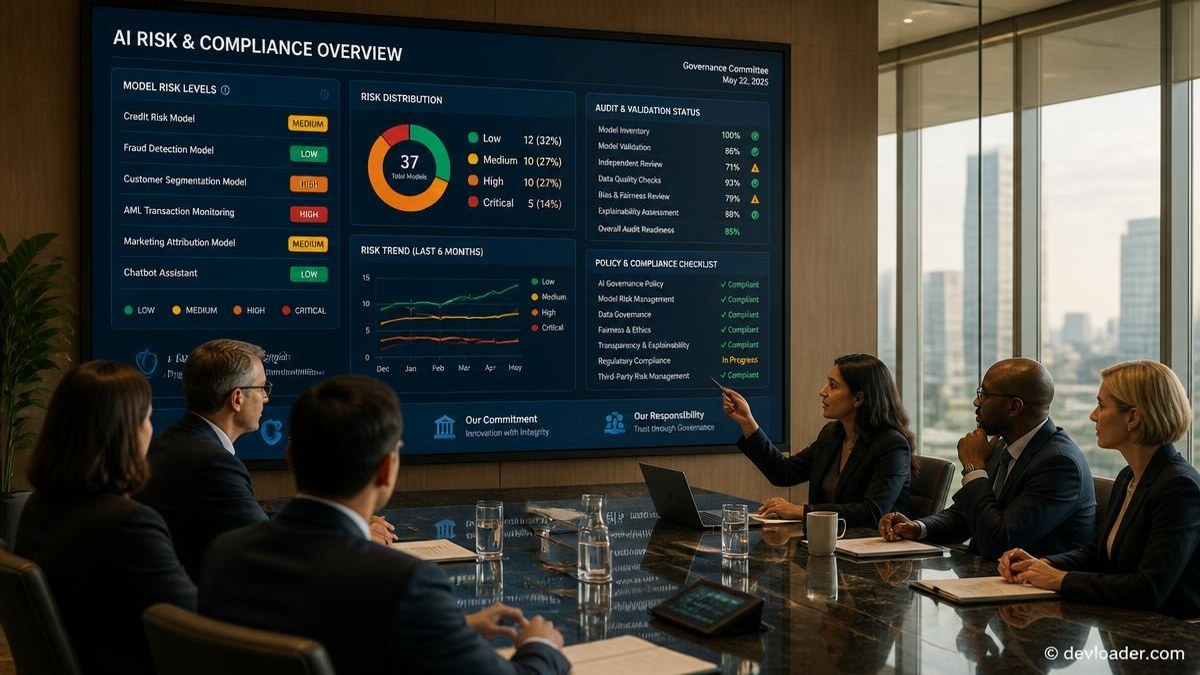
What is the primary focus of AI governance?
The primary focus of AI governance is aligning machine learning initiatives with organisational values, regulatory requirements, and risk management protocols — before deployment, not after an incident.
Whether you run centralised oversight (one committee approving everything) or decentralised oversight (embedded owners inside each business unit), the objective is identical: safe, reliable, explainable, and fair outcomes. Centralised models give you consistency and are easier to audit; decentralised models move faster and scale better across global branches. Most enterprises end up hybrid — central policy, local execution.
Governance also has to be responsive. A framework written for classification models will not survive contact with generative systems, so review cadence matters as much as the rules themselves. That responsiveness is what allows you to measure social impact — how the technology affects users, employees, and society — rather than only tracking financial return.
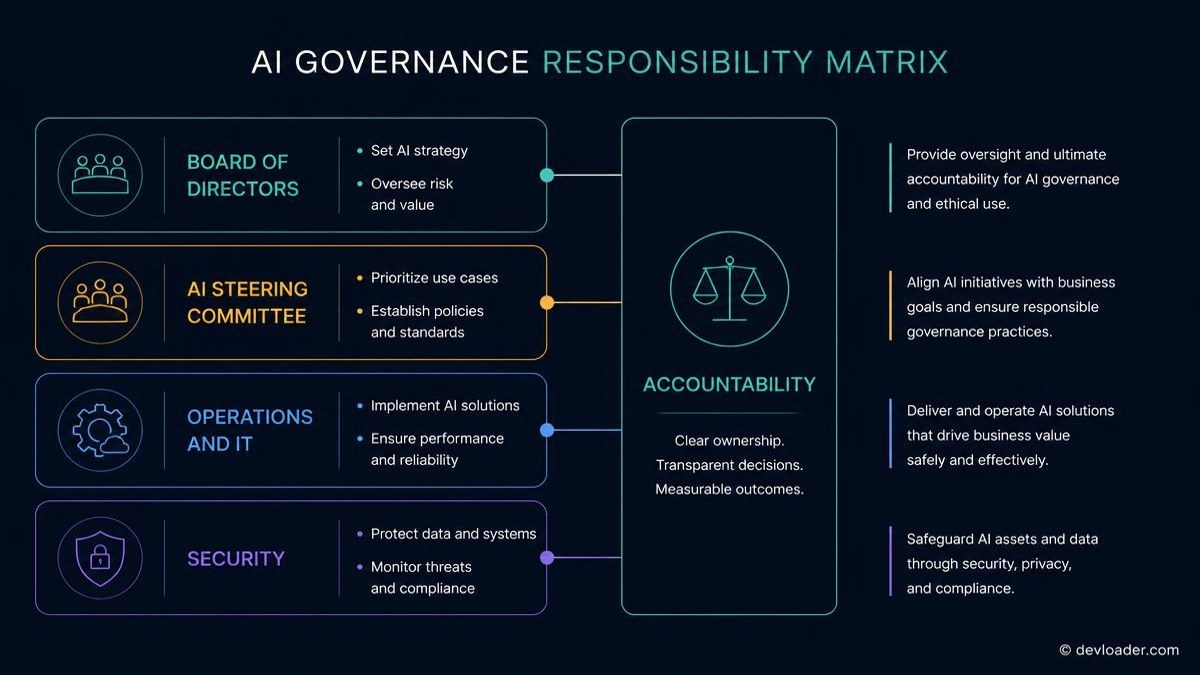
Defining core AI governance responsibilities by role
Successful implementation is never a solo effort. Clear delegation is what prevents oversight gaps and makes accountability definitive.
- Executive leadership and the board. The tone is set at the top. The board allocates budget, approves risk appetite, and formally adopts corporate AI ethics policy, ensuring long-term AI strategy tracks business goals.
- The AI steering committee. A cross-functional group — IT, legal, HR, security, and compliance — that owns framework development, reviews high-risk use cases, and arbitrates trade-offs no single department can settle.
- Operations and IT. These teams own operational governance: model uptime, performance drift, retraining triggers, and routine technical maintenance.
- Security. Cybersecurity owns AI security governance — protecting models from adversarial input, data poisoning, prompt injection, and unauthorised access to training data.
- Product and legal. Product defines the intended use and the boundaries of that use; legal maps each system to the regulations that apply in every market you serve.
Building an artificial intelligence governance framework
An effective artificial intelligence governance framework turns abstract ethical principles into daily practice. A responsible AI roadmap should state exactly what happens from conception through deployment and decommissioning.
The cornerstone is an ethical implementation framework — non-negotiable principles covering fairness, privacy, human oversight, and well-being. Those principles only become real when they are backed by documentation. Track training data provenance, model versions, evaluation results, and logic changes so that when a system behaves unexpectedly, you can reconstruct why.
Technical teams also need explainability standards. When a regulator, customer, or journalist asks how a decision was reached, "we don't know" is not an acceptable answer. Leaders must balance that transparency against intellectual property: explain the decision logic to auditors and affected users, while protecting the proprietary implementation that gives you a competitive edge. In practice this means documenting features, weights of influence, and decision boundaries — not shipping your source code.
Finally, teams should master AI impact assessments. Conducted before production, these evaluate potential harms — discrimination, privacy violation, safety failure — while changing course is still cheap. The same discipline we apply when building AI workflows with an agent builder applies here: cap autonomy, log everything, and gate destructive actions behind human approval.
Mitigating bias and managing third-party AI vendors
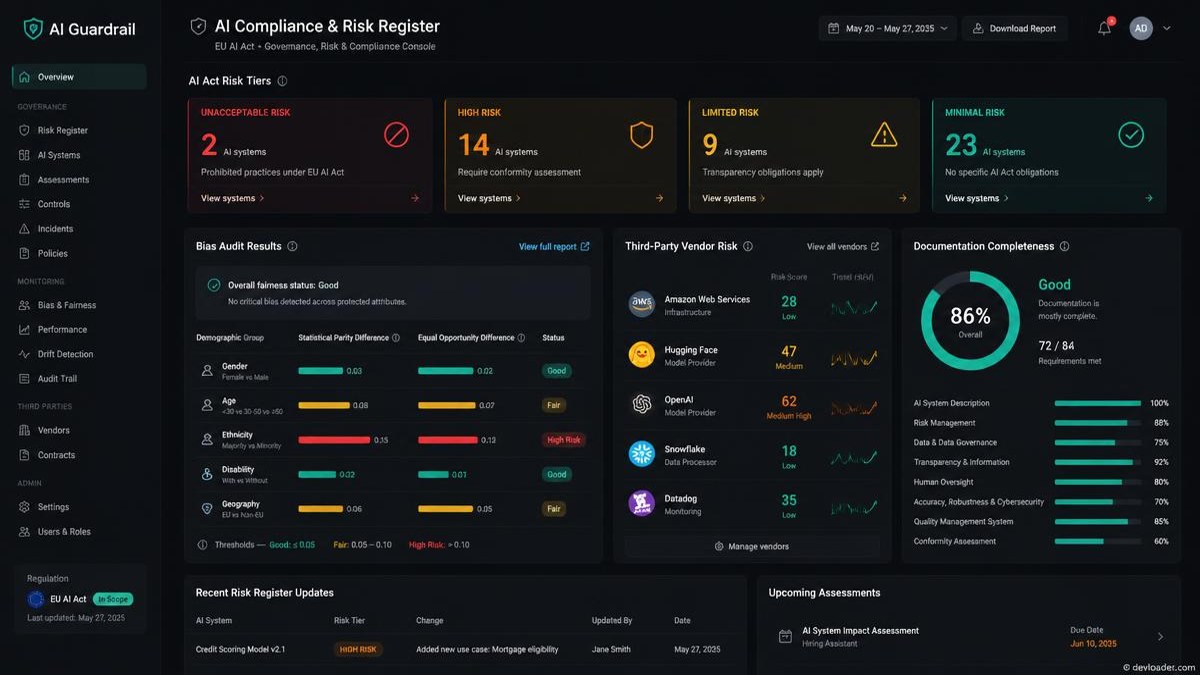
Even with good intentions, autonomous systems cause harm. Mitigating automated bias is continuous work, not a launch checklist item. Governance teams should audit training datasets for historical prejudice, test outputs across demographic groups, and re-test after every retraining cycle — model drift moves fairness metrics as surely as it moves accuracy.
Very few companies build AI entirely in-house. Heavy reliance on external APIs and foundation models makes third-party vendor risk a top governance priority, and your responsibilities extend to every tool you buy. Vet vendors on data handling, model update policy, incident disclosure, and sub-processor lists. If a purchased tool produces biased or inaccurate output under your brand, your company absorbs the reputational damage — the vendor terms of service will not protect you in public.
A practical vendor gate we recommend: no external model reaches production without a documented owner, a recorded risk tier, a fallback if the API fails, and a review date. Teams selecting AI tooling can start from our comparison of the top AI tools for business and our review of AI coding assistants, both of which flag the data and security questions worth asking before purchase.
Navigating AI governance compliance
The regulatory landscape is tightening globally, which makes compliance a delivery requirement rather than a legal afterthought.
The EU AI Act categorises systems by risk level — unacceptable, high, limited, and minimal — and imposes transparency, documentation, human-oversight, and risk-management duties on high-risk applications. Non-compliance carries severe financial penalties and, in the worst case, market exclusion. The first practical step for most organisations is simple and often skipped: build a complete inventory of every AI system in use, including the ones a team adopted on a credit card.
Privacy is the second front. Generative models consume vast amounts of data, which raises the risk of memorising and reproducing personal information. Data anonymisation, retention limits, prompt and output filtering, and clear guardrails on what may be sent to an external model are the controls that keep generative systems inside GDPR and comparable laws.
A 90-day AI governance starter plan
- Days 1–15: inventory. Catalogue every AI system and AI-enabled vendor tool, with an owner named for each.
- Days 16–30: risk-tier everything. Map each system to EU AI Act-style tiers and flag anything touching hiring, credit, health, or safety.
- Days 31–45: stand up the committee. Name members, set decision rights, agree what requires sign-off and what does not.
- Days 46–60: write the minimum policy. Acceptable use, data handling, human-oversight requirements, and a documentation template.
- Days 61–75: instrument. Logging, drift monitoring, bias metrics, and an incident escalation path.
- Days 76–90: run one impact assessment end to end. Use a real system, fix what the process reveals, then scale the process.
Final thoughts
Governing artificial intelligence takes more than technical expertise; it takes clear human accountability. By defining your AI governance responsibilities — bias mitigation, cross-functional oversight, lifecycle documentation, vendor diligence, and regulatory compliance — you protect your customers, your brand, and your ability to keep innovating.
Put governance around your AI systems with Dev Loader
Dev Loader LLC builds and hardens production AI features — model integrations, audit logging, access controls, documentation, and the monitoring that makes oversight real rather than theoretical. If you are formalising AI governance responsibilities across a product or an organisation, we can help you design the framework and implement the technical controls behind it.
Request a project quote or explore our development services to start the conversation.