How to Hire Developers for a Startup: Expert Tips
A founder-tested playbook for hiring developers for a startup: co-founder vs first engineer, generalists vs specialists, where to source talent, equity compensation, and how to vet and retain engineers.
Launching a venture is thrilling, but turning a visionary idea into a working digital product requires the right technical minds. If you want to hire developers for startup growth, you have to navigate a competitive and expensive talent market — and the process goes far beyond posting on a generic job board.
You need builders who understand agile delivery, align with your business goals, and thrive on rapid iteration. Whether you need a programmer for an MVP or want to scale an existing platform, knowing how to find a developer who fits your culture is what separates a six-week build from a six-month stall.
Key takeaways
- Decide your technical leadership model first: technical co-founder, first engineer, or fractional CTO.
- Hire generalists early; specialists become worth it only after product-market fit.
- Nearshore buys time-zone overlap; offshore buys budget headroom. Pick the constraint that hurts most.
- Equity, transparency, and real ownership close the gap when you cannot match corporate salaries.
- Replace whiteboard interviews with short, paid, realistic assessments.
- Retention is cheaper than recruitment — invest in async culture and psychological safety.
Establishing your early tech foundation
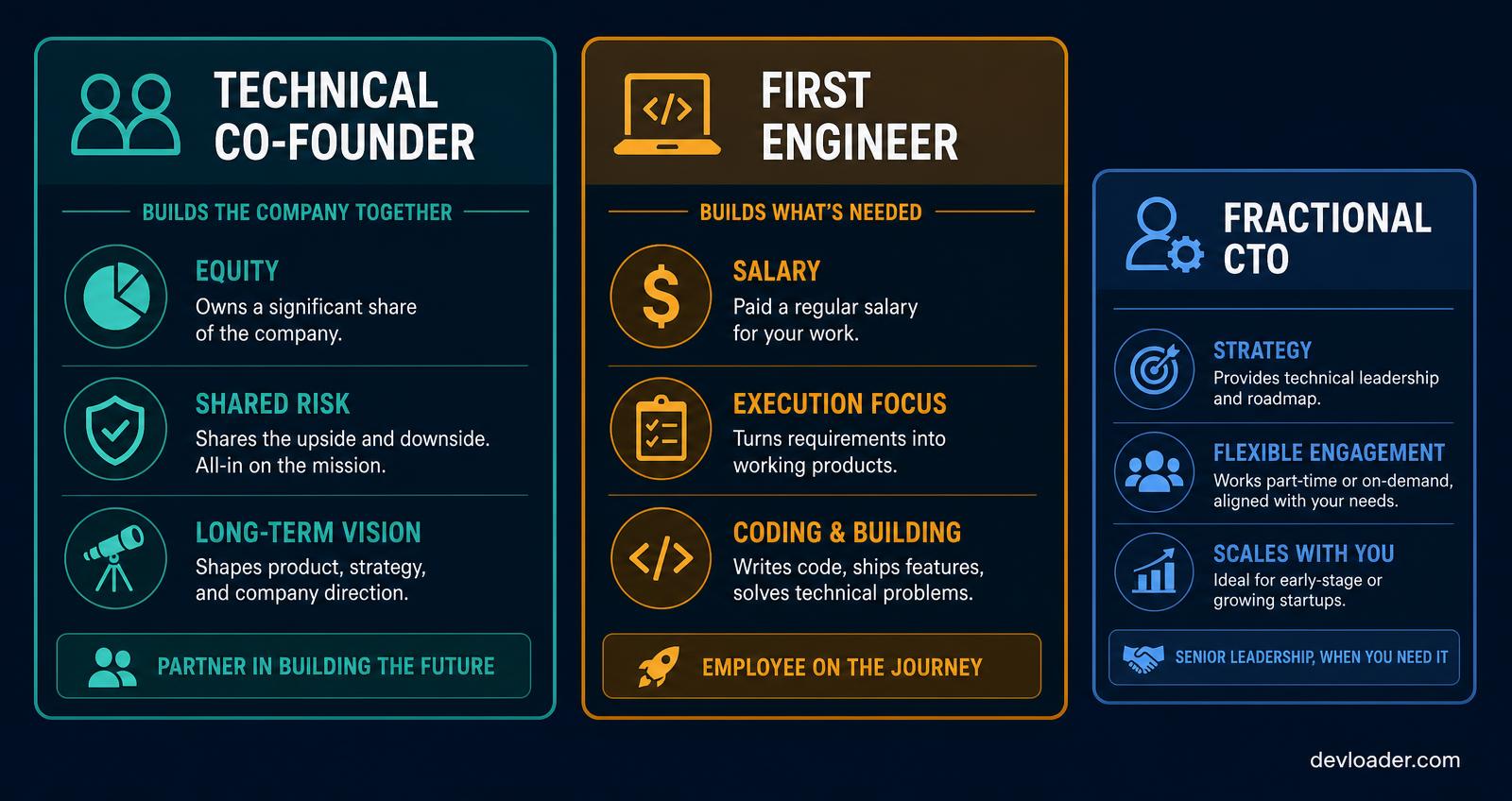
*Technical co-founder, first engineer or fractional CTO — each buys you a different kind of leverage. Diagram © devloader.com*
Before you rush to find software engineers, define your technical leadership. Many founders debate a technical co-founder vs first engineer. A co-founder shares the risk, takes equity instead of a market salary, and owns the long-term technical vision. A first engineer focuses on execution and shipping code.
If you lack a technical background but are not ready to give away double-digit equity, a fractional CTO is the pragmatic middle path. A fractional CTO can:
- Guide your architecture strategy and vendor choices.
- Help you evaluate and screen candidates you cannot assess yourself.
- Define the minimum viable product development team structure and hiring order.
Experienced leadership early clarifies what talent you actually need — and stops you from hiring three engineers when one senior generalist would do. If you are still scoping the build itself, our guide on how to build a SaaS MVP in 30 days shows the scope discipline that makes a small team enough.
Choosing roles: generalists vs specialists
In early-stage environments, flexibility is survival. You will face the full-stack developer vs specialized engineer decision quickly. In the first year, full-stack engineers are invaluable: they handle front-end interfaces and back-end data work, and adapt when requirements pivot mid-sprint.
What technical skills should you prioritize in early-stage hiring?
- Core framework mastery (React, Node.js, or your chosen stack)
- Cloud deployment and working DevOps knowledge — CI/CD, logs, rollbacks
- Autonomous problem-solving and comfort with ambiguity
- Product instinct: the ability to argue that a feature is not worth building
As your user base grows, specialists in machine learning, data engineering, or security start paying for themselves. Before then, they idle. Budget matters here too — our app development cost guide and the MERN stack cost breakdown give realistic salary and build ranges to plan around.
Where to find the right talent
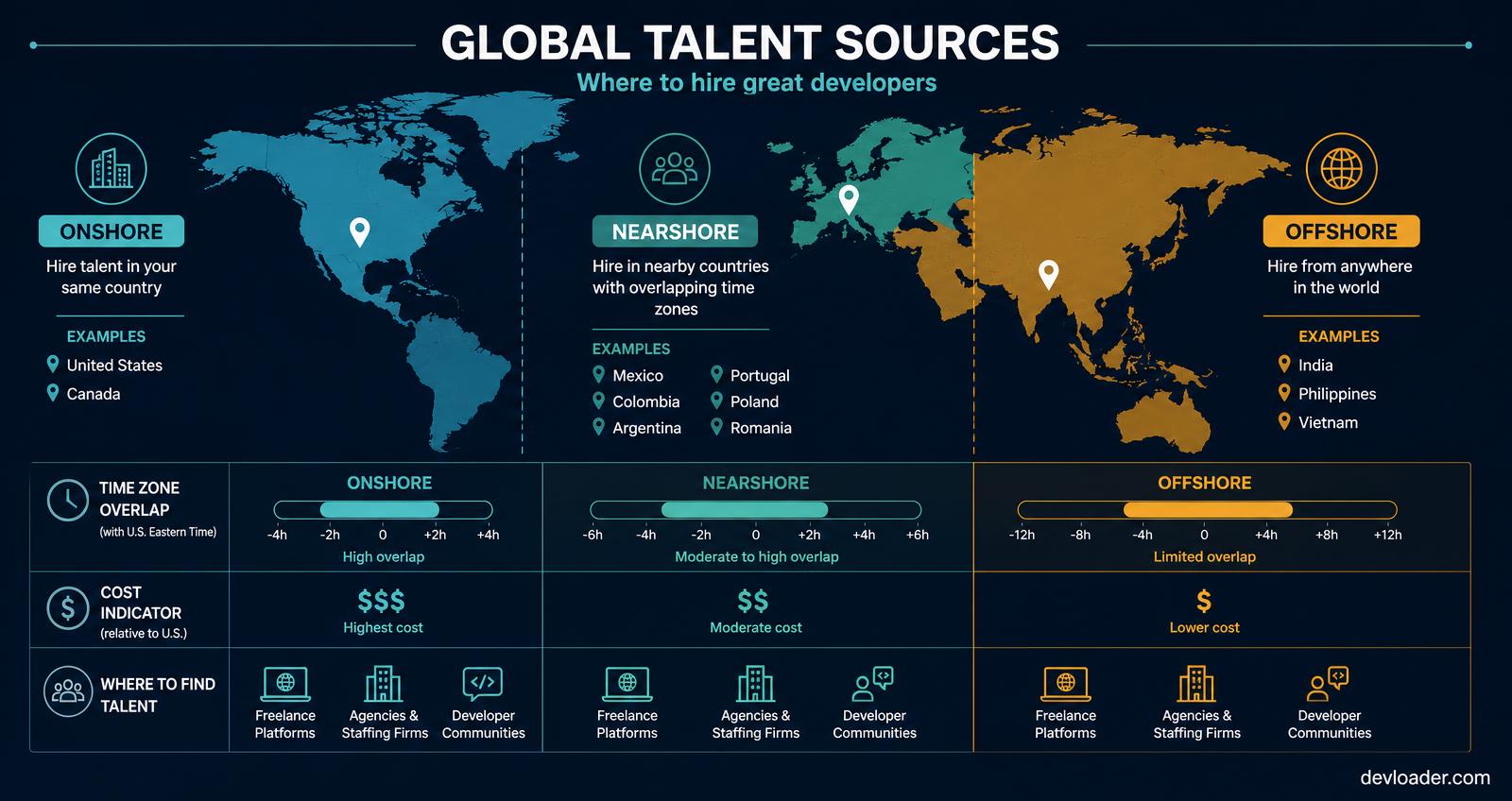
*Onshore, nearshore and offshore hiring trade cost against time-zone overlap. Diagram © devloader.com*
Knowing where to look saves months. If you are bootstrapping, offshore talent pools in Eastern Europe, Latin America, and South and Southeast Asia deliver strong engineering at a fraction of US rates.
When comparing offshore vs nearshore development teams, the trade is simple: nearshore teams share most of your working day, which makes stand-ups, pairing, and incident response painless. Offshore teams are usually cheaper and can extend your coverage window, but they demand real async discipline and written specs.
You should also weigh freelance platforms against specialized recruitment agencies. Platforms like Upwork and Toptal are efficient for scoped, short engagements; agencies and dedicated teams make more sense for a long-lived product where continuity matters. Beyond both, the highest-signal sourcing channel is still community: GitHub contributors in your stack, Stack Overflow answerers, and focused Slack and Discord groups. Founders hiring in specific ecosystems can start with our playbooks on hiring Next.js developers and hiring a Laravel developer.
Attracting candidates on a tight budget
Attracting top talent with a limited budget is the classic founder problem: you cannot beat corporate base salaries, so you have to win on everything else.
Start with the job description. An effective software developer job description names the mission, the real tech stack, the size of the codebase, who the developer reports to, and the specific impact they will have on users. Vague listings attract vague candidates.
Then use equity deliberately. Equity compensation aligns an early engineer's outcome with yours — but only if it is legible. Be transparent about:
- Runway and current funding stage
- Percentage ownership, not just share count
- Strike price, vesting schedule, and cliff
- The product roadmap they are being asked to build
Ambitious engineers accept lower cash for ownership and autonomy. They rarely accept it for ambiguity. Remote-first offers widen your pool considerably — see what candidates are actually looking for in remote developer jobs.
Vetting and retaining your new team
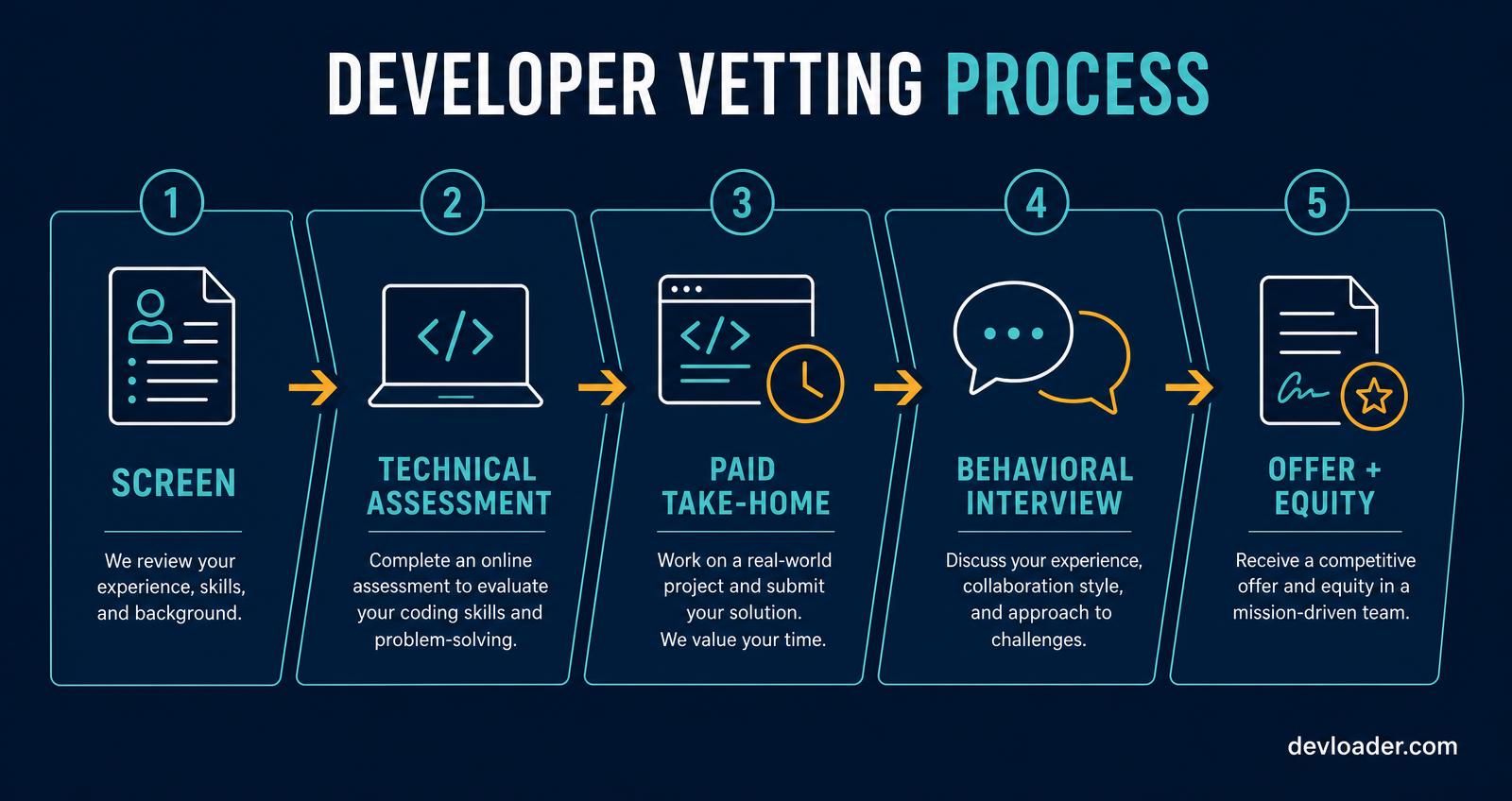
*A five-stage funnel that respects candidate time and still filters hard. Diagram © devloader.com*
Once applicants arrive, vetting becomes the bottleneck. Skip high-pressure whiteboard sessions — they select for interview practice, not engineering judgement. Instead:
- Screen for evidence. Read shipped code, repositories, and case studies before any call.
- Use realistic assessments. Pair on a bug in a sandboxed version of your own codebase rather than an algorithm puzzle.
- Pay for take-home work. A short, compensated, three-hour task is the most accurate and most respectful signal you can buy.
- Interview for behaviour. Ask how they handled a shipped mistake, a disagreement with a founder, and an ambiguous spec.
- Check references properly. One specific question — "would you hire them again?" — surfaces more than a résumé review.
Recruitment is only half the job. Reducing developer turnover in a fast-growing company protects your momentum, because every departure costs roughly three to six months of context. Build a scalable remote engineering culture with written decisions, async-first communication, a learning stipend, and psychological safety. Agile practices help here too — see the key principles of agile project management for the delivery cadence that keeps small teams shipping.
Common hiring mistakes to avoid
- Hiring a specialist first. You need range before depth.
- Interviewing without a scorecard. Unstructured interviews reproduce bias and produce inconsistent hires.
- Offering equity without explaining it. An unexplained grant reads as a discount, not an incentive.
- Skipping a paid trial. Two weeks of real work predicts performance better than five interviews.
- Hiring for the roadmap you wish you had. Hire for the next nine months of work.
FAQ
How much does it cost to hire developers for a startup?
Cost depends heavily on location and seniority. US-based senior engineers typically run $130k–$190k plus equity, Western Europe $80k–$130k, and Eastern Europe, Latin America, or South Asia $30k–$75k for comparable skill. Dedicated agency teams are usually billed monthly per engineer and include management, hiring, and replacement cover.
Should my first hire be a technical co-founder or a first engineer?
Choose a technical co-founder if you need someone to own the technical vision, share the risk, and stay for years — and if you can part with meaningful equity. Choose a first engineer if you already have technical direction and need execution. A fractional CTO plus a strong engineer is a common compromise.
Where can I find developers for a startup with a small budget?
Nearshore and offshore talent markets, developer communities on GitHub and Stack Overflow, niche job boards for your stack, and vetted freelance platforms. A development partner can also be cheaper than direct hiring in year one because there is no recruitment, onboarding, or bench cost.
How much equity should I give an early developer?
Typical ranges are 0.5%–2% for an early engineering hire and 5%–15% for a technical co-founder, with a four-year vest and a one-year cliff. The percentage should reflect risk taken, cash discount accepted, and the stage at which they join.
Should I hire full-stack or specialized developers first?
Full-stack first. Early products change scope weekly, and a generalist who can move across the front end, back end, and deployment removes handoffs. Bring in specialists once traffic, data volume, or compliance forces the issue.
How do I vet a developer if I am not technical?
Bring in a fractional CTO or a trusted senior engineer for the technical assessment, use a short paid take-home reviewed by that expert, and check references who worked with the candidate directly. Do not substitute a certification list for a code review.
How long does it take to hire a startup developer?
Direct hiring realistically takes six to twelve weeks from job description to start date. Engaging a vetted development partner or agency usually compresses this to one to two weeks, which matters when the runway is measured in months.
Is it better to outsource development or hire in-house?
Outsource when speed matters, scope is defined, or you are still validating the idea. Hire in-house when the product is core intellectual property, requires continuous iteration, and you have funding to support salaries for at least twelve months. Many startups do both: an agency builds the MVP, then an in-house team takes it over.
Related content
- How to build a SaaS MVP in 2026 (in 30 days) — the scoping discipline that makes a two-person team enough.
- App creation cost guide — realistic budgets before you write a job description.
- Jobs remote developer: work from home opportunities — what remote engineers look for in an offer.
- How to hire Next.js developers in 2026 — screening questions for React and Next.js roles.
- How to hire a Laravel developer in 2026 — the PHP-side equivalent playbook.
- Master key principles of agile project management — the delivery cadence for small engineering teams.
Build your startup team with Dev Loader
Hiring takes months you may not have. Dev Loader assembles vetted product engineering squads — full-stack developers, DevOps, and QA — that plug into your startup and ship an MVP or scale an existing platform without a recruitment cycle.
Tell us what you are building and request a project quote; you will get a scoped proposal with team profiles, timeline, and a fixed price within 48 hours. You can also explore our web application development service or see recent work.
About the author
Dev Loader Editorial is the in-house engineering and content team at Dev Loader LLC, a software development company headquartered in Washington, DC. We staff and run engineering squads for startups and scale-ups, and this guide reflects hiring, vetting, and retention practices we apply on live client engagements — not theory. Our sourcing and correction standards are published in our editorial policy.