How to Fact-Check Content Written by AI (A Practical Playbook)
A practical, tested playbook for fact-checking AI content — including the specific hallucinations to look for, the tools that catch them, and a 10-minute audit you can run before publishing.
*A practical, tested playbook for fact-checking AI content — including the specific hallucinations to look for, the tools that catch them, and a 10-minute audit you can run before publishing.*
Why AI still hallucinates in 2026
Even the best models — GPT-5.1, Claude 3.7, Gemini 2.5 — invent facts under three conditions: when a question is very specific, when the training data is thin on the topic, or when the model is trying to be helpful about something it doesn't actually know.
The four kinds of AI hallucination to watch for
Fabricated statistics. Misattributed quotes. Non-existent sources (URLs, books, studies). And confidently wrong dates. Every fact-check pass should scan for those four in order.
Step 1: Highlight every number, name, quote, date, and URL
Before you check anything, mark every one of those five items in the draft. Every marked item is a claim that needs verification.
Step 2: Verify statistics against a primary source
AI is worst at statistics. Google the exact number in quotes plus the word "source." If the only results are AI-generated pages repeating each other, it's probably fabricated.
Step 3: Verify quotes with a targeted search
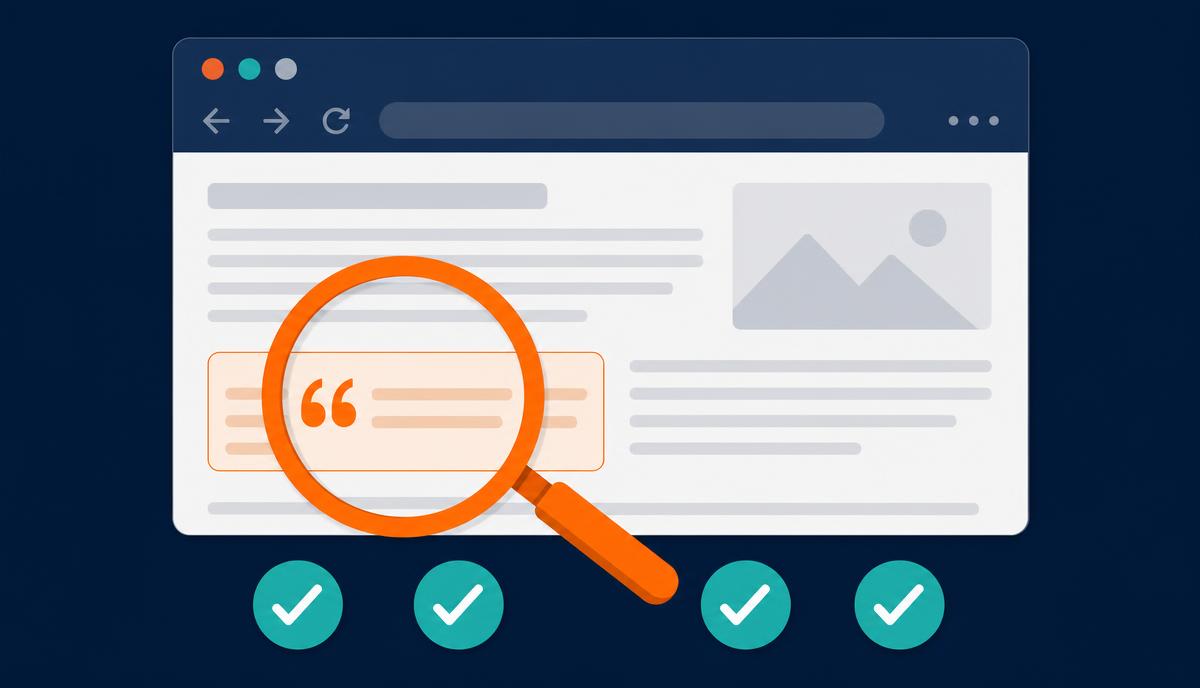
Search the first eight to ten words of the quote in Google, in double quotes. If it doesn't appear on a reputable page, either the quote is invented or the attribution is wrong.
Step 4: Verify sources by opening the URL
Never trust a URL an AI hands you. Open every one. It's astonishingly common for the URL to 404 or point to something unrelated.
Step 5: Verify dates against a reliable timeline
AI often gets years right and specific months wrong. For any date-sensitive claim, cross-check with a news source you trust.

A 10-minute audit for any AI draft
Two minutes highlighting claims. Three minutes verifying stats. Two minutes verifying quotes. Two minutes opening URLs. One minute spot-checking dates.
The one AI feature that actually helps fact-checking
Turn on "web browsing" or "grounded search" mode. Every major AI now has one. It cuts hallucinations by an order of magnitude, though not to zero.
How to instruct an AI to be more accurate
Two prompt lines make a real difference: "Only include facts you can cite to a specific, verifiable source" and "If you are not sure, say I don't know instead of guessing."
Legal risk of publishing unchecked AI content
Publishing false statements about real people can expose you to defamation liability, even if an AI generated them.
FAQ
What's the fastest way to fact-check an AI-written article?
Highlight every number, name, quote, date, and URL, then verify each. Ten minutes for a 1,500-word article once you're used to it.
Do modern AIs still hallucinate?
Yes, less than before but meaningfully. Any AI-written content published without fact-checking will eventually be wrong in public.
Key takeaways
- Fact-check AI content for hallucinations to ensure accuracy.
- Focus verification on numbers, names, quotes, dates, and URLs.
- Use primary sources to verify statistics and reliable searches for quotes.
- Always open AI-provided URLs; they are often broken or irrelevant.
- Enable AI's web browsing mode and use specific prompts for accuracy.
- Unchecked AI content carries significant legal risks and reputational damage.
Why a robust AI content fact-checking process is crucial for online publishers
Implementing a robust AI content fact-checking process is paramount for any online publisher utilizing generative AI. Beyond the immediate risks of reputation damage and legal liability for defamation, inaccurate content erodes reader trust, diminishes your site's authority, and can negatively impact your search engine rankings. Google's E-E-A-T (Experience, Expertise, Authoritativeness, Trustworthiness) guidelines heavily penalize content that is unreliable, factually incorrect, or misleading. Relying solely on AI without human oversight can lead to a consistent output of "confidently wrong" information, which search algorithms are increasingly adept at identifying and demoting.
Furthermore, publishing verifiable, high-quality content differentiates your platform in an increasingly crowded digital landscape. While AI can accelerate content creation, human fact-checking ensures that speed doesn't come at the cost of accuracy. This human-in-the-loop approach protects your brand, preserves journalistic integrity, and ultimately builds a loyal, informed audience. It’s an investment in sustainable content quality and a safeguard against the inherent limitations of current AI models.
Real-world example
Consider a tech blog that used an AI to generate an article titled "The Future of Quantum Computing: Qubit Advances in 2026."
- AI Output: The article stated, "IBM's Osprey processor achieved a stable 1,337 qubits in early Q1 2026, marking a 50% increase from its PFN-7 model..."
- Fact-Check Audit:
- Claim Highlight: "1,337 qubits," "Q1 2026," "PFN-7 model."
- Statistic Verification (Google:
"1,337 qubits" IBM Osprey source): Search results primarily showed AI-generated summaries and speculative articles. No direct IBM press release or peer-reviewed paper from Q1 2026 confirmed this specific qubit count. - Model Name Verification (Google:
"IBM PFN-7 model"): This search yielded no results, indicating the model name was fabricated. IBM's known processors were "Eagle" (127 qubits) and the announced "Condor" (1,121 qubits), with projected timelines.
- Finding: The "1,337 qubits" statistic was a fabrication, likely an AI "leet speak" hallucination, and the "PFN-7" model non-existent.
- Correction: The human editor corrected the figures to align with publicly reported numbers for IBM's quantum roadmap, citing an official IBM blog post from late 2025 discussing their Condor processor and future projections. This ensured the article remained forward-looking but factually grounded.
Step-by-step implementation
- Define Your AI's Brief: Begin by crafting a clear, detailed prompt for your AI. Include instructions like
"Cite all sources you use directly in your output"and"Do not invent information." - Generate Draft Content: Use your chosen AI model (e.g., GPT-4, Claude 3) to generate the initial article draft based on your prompt.
- Initial Scan for Red Flags: Read through the AI draft quickly, looking for overly confident or vague statements, complex statistics, direct quotes, or external links. These are prime candidates for AI hallucination.
- Highlight Claims for Verification: Implement Step 1 from the main article: highlight every number, name, quote, date, and URL.
- Systematic Verification: Proceed with Steps 2-5 outlined previously: verify statistics, quotes, URLs, and dates using reputable search engines and primary sources.
- Apply Accuracy Prompts (if needed): If the AI repeatedly hallucinates specific types of facts, reiterate accuracy instruction in follow-up prompts. For instance,
“Recheck the statistics. Ensure they are from [specific reputable source] and not a secondary report.” - Final Human Review: After all specific claims are verified, conduct a holistic review of the article for flow, tone, and overall coherence. Ensure the content accurately reflects the validated facts and addresses the initial brief.
- Document Findings: Maintain a simple log of verified facts and corrected hallucinations. This helps identify common AI pitfalls specific to your content niche.
Common pitfalls and how to fix them
- Pitfall: Over-reliance on AI's built-in "web browsing" mode. Fix: While helpful, AI's browsing mode is not a substitute for human verification. It can still misinterpret sources or pull less authoritative data. Always cross-check the sources it cites.
- Pitfall: Treating every AI output as equally reliable. Fix: Recognize that AI performs better on widely documented, general knowledge topics than on niche, rapidly evolving, or highly technical subjects. Adjust your fact-checking intensity accordingly.
- Pitfall: Ignoring the "recency" of AI training data. Fix: Be extra vigilant with claims about very recent events, new products, or cutting-edge research. Most public AI models have knowledge cutoffs, making them prone to hallucinations on current affairs.
- Pitfall: Falling for convincing but non-existent citations. Fix: AI can invent legitimate-looking journal titles, authors, or even DOIs. Always attempt to locate the actual source; if it doesn't exist, it's a hallucination.
- Pitfall: Only checking the "big" facts and missing smaller inaccuracies. Fix: AI often gets minor details wrong, like the exact year of a minor event or the specific role of an individual. A thorough audit requires attention to all highlighted claims.
When to use this vs. alternatives
Feature / Method — Fact-Checking AI-Generated Content (This Playbook) — Fully Manual Human Fact-Checking — Specialized Fact-Checking Software (e.g., NewsGuard, Factmata)
Speed — Fast (10-minute audit per 1.5k words) — Slow (time-consuming research) — Moderate (automated scan, then human review)
Cost — Low (staff time + basic tools) — Moderate (extensive staff time) — High (subscription fees)
Primary Use Case — Routine content processing, high-volume blogs — High-stakes journalism, legal documents — Large news organizations, combating misinformation at scale
Accuracy — High (human judgment on AI output) — Very High (deep dive, domain expertise) — Variable (AI-driven, but prone to errors itself)
Required Expertise — Basic research skills, critical thinking — Deep domain knowledge, investigative skills — Tool operation, understanding of AI strengths/weaknesses
Hallucination Focus — Explicitly targets AI-specific errors — Broader focus on all factual errors — Primarily identifies known misinformation patterns
FAQ
How can I train my team to fact-check AI-generated content efficiently?
Start with this practical playbook, conduct hands-on workshops, and provide templates for highlighting and verifying claims. Regular practice and feedback significantly improve efficiency.
What are the main types of AI hallucinations I should prioritize checking?
Focus on fabricated statistics, misattributed quotes, non-existent sources (URLs, books), and confidently incorrect dates. These are common and easily verifiable errors.
Can I trust AI tools that claim to fact-check content automatically?
While some tools provide preliminary checks, they should not be entirely trusted. Automated tools can miss nuances, struggle with context, and may even introduce their own errors. Human oversight remains essential.
How does fact-checking AI improve my website's SEO?
Ensuring factual accuracy through fact-checking builds E-E-A-T (Experience, Expertise, Authoritativeness, Trustworthiness), a crucial Google ranking factor. High-quality, reliable content is favored by search engines.
What's the difference between AI hallucination and regular human error?
AI hallucination refers specifically to the model generating plausible but factually incorrect information that isn't present in its training data, often due to patterns it "learned." Human error is simply a mistake made by a person.
Should I disclose to my audience that I use AI for content creation?
Transparency is becoming a best practice. Disclosing AI usage can build trust, especially when coupled with a clear statement about your human oversight and fact-checking process.
Related concepts
- Google's E-E-A-T Guidelines: Understand how factual accuracy and expertise contribute to your website's search engine ranking and perceived authority.
- AI Ethical Guidelines: Explore broader principles for responsible AI deployment beyond just content creation, including fairness, transparency, and accountability.
- Prompt Engineering: Learn how to craft more effective prompts to improve the initial quality and reduce the hallucination rate of AI-generated content.
- Information Literacy in the Digital Age: Develop skills to critically evaluate all forms of digital information, which is increasingly important in an AI-driven content landscape.
- Defamation Law: Familiarize yourself with the legal implications of publishing false statements, especially about individuals or organizations, even if an AI generated the initial draft.