How to Create an AI: Step-by-Step Guide
Learn how to create an AI from scratch with our step-by-step guide. Discover how to build, train, and deploy your own artificial intelligence system today!
Have you ever wondered how to create an AI of your own? The question behind it is usually simpler: *can I build this without a research lab behind me?* The honest answer in 2026 is yes — the frameworks are open source, the compute is rentable by the hour, and the hardest parts are data discipline and scope, not maths.
This guide walks the full path: the concepts you actually need, how to gather and clean training data, which tools to pick, how training really works, what deployment costs, and the ethics and maintenance work that keeps a model useful after launch. For budgeting and tooling decisions alongside it, see our breakdown of AI agent development cost, the best free LLM API platforms and how agentic AI frameworks orchestrate multi-step work.
What we learned building AI features in production
We build AI features into client products for a living, and the pattern that separates shipped models from abandoned notebooks is consistent. Projects that succeed start with one narrow, measurable task — classify these tickets, extract these fields, rank these leads — and a labelled evaluation set of a few hundred examples written *before* any model is trained. Projects that stall start with "add AI to the product."
The second consistent lesson: most teams do not need to train anything from scratch. Roughly four out of five business problems we scope are better solved by fine-tuning an existing model or retrieving over your own data than by building a network from zero. Train from scratch only when your data is genuinely unlike anything a pretrained model has seen. Everything below assumes you have made that call deliberately.

Step 1: Grasp the core concepts
Before you set up an AI project, get the vocabulary straight — it determines which tutorials apply to you.
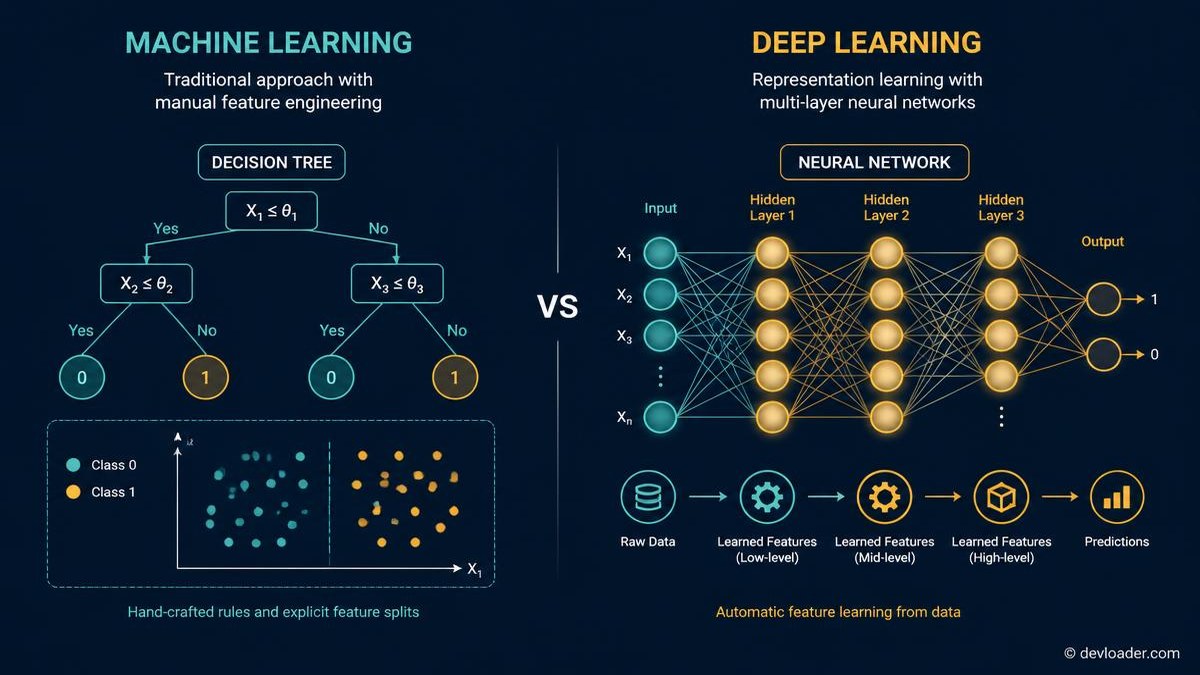
Machine learning uses statistical algorithms to find patterns in structured data. Think gradient-boosted trees predicting churn from twenty columns. It is fast to train, cheap to run, and often more accurate than a neural network on tabular problems.
Deep learning uses multi-layer neural networks that learn their own features from raw input — pixels, audio, text. It needs far more data and compute, and it is what powers image recognition and large language models.
You do not need a PhD to build your own AI. You do need comfort with Python, a working understanding of training and validation splits, and enough statistics to know when a result is real rather than a fluke of a small test set.
Step 2: Gather and preprocess your data
Data is where AI projects are won or lost. To build your own AI model you need examples that reflect the situation the model will face in production — not the cleanest slice of it.
Practical sequence:
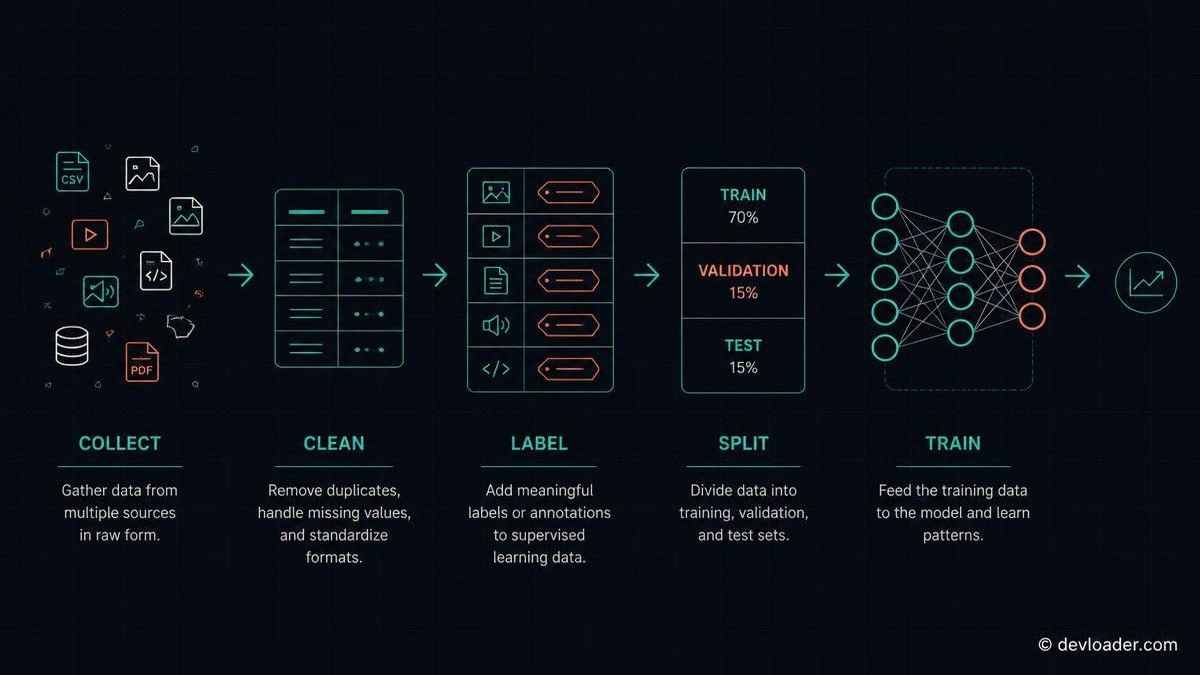
- Collect from the sources you will actually have at inference time. A feature that exists in your warehouse but not in the live request is useless.
- Clean — deduplicate, handle missing values, fix inconsistent formats and obvious label errors.
- Label consistently. Write a labelling guide, have two people label the same 100 examples, and measure agreement. Below ~85% agreement, your task definition is the problem, not your model.
- Split into train, validation and test sets before you look at the data. For time-series or user-level data, split by time or user, never at random, or you will leak future information and celebrate a score that collapses in production.
Garbage in, garbage out is not a cliché here — it is the single best predictor of project outcome.
Step 3: Choose your tools
Python remains the default language to create artificial intelligence software, purely because of its library ecosystem.
Need — Reach for
Tabular / classic ML — scikit-learn, XGBoost, LightGBM
Deep learning research — PyTorch
Production serving at scale — TensorFlow / PyTorch + a serving runtime
Text and LLM work — Hugging Face Transformers, PEFT/LoRA
Data handling — pandas, Polars, DuckDB
On the PyTorch vs TensorFlow question: PyTorch dominates research and is now the common default for new projects thanks to its dynamic graph and readable debugging. TensorFlow retains strengths in mature production tooling and mobile/edge deployment. Either is a defensible choice — pick the one your team can debug at 2am.
Step 4: Design and train the model
Architecture choice follows the data. Tabular data wants gradient boosting. Images want a convolutional network or a vision transformer. Sequences and text want a transformer. Resist the urge to design something novel on your first project; start from a known-good baseline and beat it.
Understand the learning paradigms before choosing:
- Supervised learning — labelled examples, e.g. spam vs not spam. Most business problems live here.
- Unsupervised learning — no labels; the model finds structure, e.g. clustering customers into segments.
- Reinforcement learning — an agent learns from reward signals. Powerful, expensive, rarely the right first project.
Training itself is a loop: feed batches forward, measure loss, backpropagate, update weights, evaluate on validation data every epoch. Then optimise — tune learning rate first (it matters more than anything else), then batch size, regularisation and architecture depth. Track every run with an experiment tracker, because untracked hyperparameter tuning is just guessing with extra steps.
If you are working with text, a large language model fine-tuning approach using LoRA or QLoRA will usually beat training from scratch at a fraction of the cost. The same orchestration patterns we describe in our guide to building AI workflows with an AI agent builder apply once your model needs to call tools or chain steps.
Step 5: Deploy your AI system
Can you build your own AI model and run it globally? Yes — and this is the stage where cost becomes real.
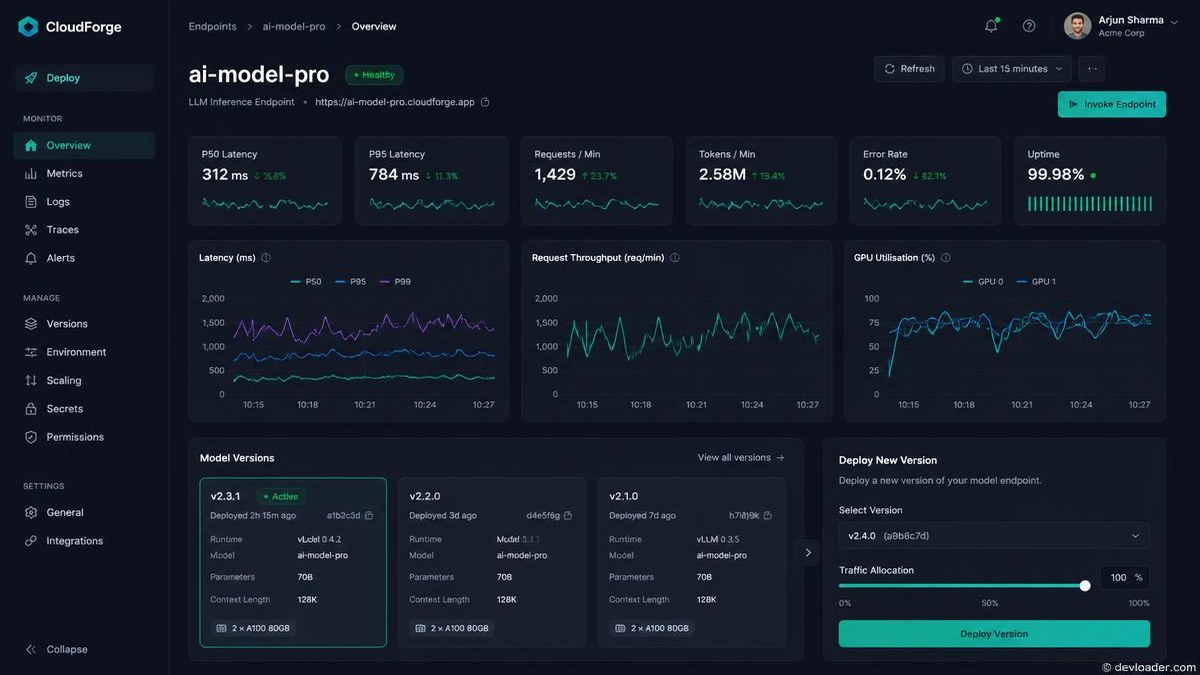
Cloud computing platforms for model hosting (AWS SageMaker, Google Vertex AI, Azure ML, or leaner GPU providers) handle the infrastructure. Your decisions are: batch inference or real-time endpoint, CPU or GPU, and how you version and roll back models.
Ballpark costs to build custom AI software:
- Wrapping an existing API — a few hundred dollars a month, days of engineering.
- Fine-tuning an open model — low thousands in compute, a few weeks of work.
- Training a large network from scratch — tens of thousands and up, plus specialist staff.
Whatever you deploy, ship monitoring on day one: latency, error rate, input distribution and prediction distribution. Also ship a fallback path for when the model is unavailable — a rules-based default beats a broken feature.
Step 6: Ethics, monitoring and retraining
Ethical considerations in AI development are not a compliance afterthought; they are a quality control. Audit your dataset for historical bias, measure accuracy separately across the groups your system affects, document what the model should never be used for, and keep a human in the loop for consequential decisions.
Maintenance matters just as much. Models degrade because the world moves — that is data drift, and it is silent. Compare live input distributions against your training distribution weekly, watch for accuracy decay on a held-out stream, and schedule retraining before performance falls off rather than after a customer notices.
The process in summary
- Define the problem — one narrow task and the metric that proves it works.
- Gather and clean data — split before you peek; label consistently.
- Select frameworks — PyTorch or TensorFlow, plus the classic ML stack for tabular problems.
- Train and optimise — baseline first, then tune learning rate and regularisation, tracking every run.
- Deploy — cloud hosting, versioning, monitoring and a fallback.
- Maintain — audit for bias, watch for drift, retrain on a schedule.
Start small, ship something narrow that works, and expand from there. That path produces a working system far more often than an ambitious architecture ever does.
Build your AI system with Dev Loader
Dev Loader LLC designs and ships production AI features for founders and product teams — data pipelines, model fine-tuning, retrieval systems, and AI agents wired into the apps you already run. We start every engagement with a scoped evaluation set and a measurable target, so you know whether the model works before it reaches your customers.
If you would rather not assemble the stack yourself, tell us about your AI project and we will return a scoped proposal, timeline and fixed quote within 48 hours. You can also browse our AI and web engineering services to see how we approach delivery.