Mastering Risk Management Frameworks for Success
Discover how robust risk management frameworks protect businesses from uncertainty and drive sustainable growth. Learn key strategies and best practices today.
A single unhedged supplier contract, one unpatched server, or one regulatory change can wipe out a quarter of revenue. The companies that survive those events are rarely luckier — they simply decided in advance how much uncertainty they were willing to carry, and who owned each threat. That decision is what risk management frameworks encode.
A framework is not paperwork. It is the operating system for how your organisation spots, scores, and answers threats before they reach the P&L. Done well, it does more than protect assets: it gives leadership the confidence to move fast, because the downside is already mapped. Framework work also overlaps with AI governance responsibilities and with the release controls covered in our guide to user acceptance testing.
What we learned rolling out risk frameworks with clients
We build the internal tooling — risk registers, control dashboards, audit trails — that companies run their governance on, and the same failure patterns repeat.
The first is a register nobody owns. A spreadsheet with 140 risks and no named accountable person is documentation, not control. The registers that work cap themselves at the risks leadership will actually review each quarter.
The second is scoring theatre. Teams argue for weeks over whether something is a 3 or a 4 on likelihood, then never change a single control. Scoring only earns its cost when a score above a threshold automatically triggers a response and a due date.
The third is that technology risk is filed separately from enterprise risk, so the board sees a clean risk report while a critical vendor API sits with no failover.

Building a foundation for risk control
Before choosing a model, build the structure it will sit in. Governance is what gives a framework teeth: when the board actively champions hazard awareness, the rest of the business treats it as real work rather than an audit chore.
The first artefact is a risk appetite statement — a short, explicit declaration of how much risk leadership will accept in pursuit of financial goals. Without it, one team gambles and another freezes, and neither can be corrected because there is no agreed line.
With that baseline set, cross-functional teams can identify internal and external threats:
- Internal: employee error, fraud, key-person dependency, legacy technology, weak change control.
- External: regulatory shifts, supplier failure, market volatility, natural disasters, cyberattack.
Mapping both sides is what removes blind spots. Most missed risks are not exotic — they are simply owned by nobody.
Choosing the right framework: ISO 31000 vs COSO
Rather than inventing a model, adopt an established one and adapt it.
ISO 31000 is principles-based and deliberately flexible. It applies to any organisation of any size and focuses on embedding risk thinking into daily decision-making rather than prescribing a control catalogue. It suits private companies, scale-ups, and operationally diverse groups.
COSO ERM is heavier and control-oriented, with strong emphasis on financial reporting, internal controls, and enterprise-wide alignment. It is the default for publicly traded institutions and anyone in scope of SOX-style reporting.
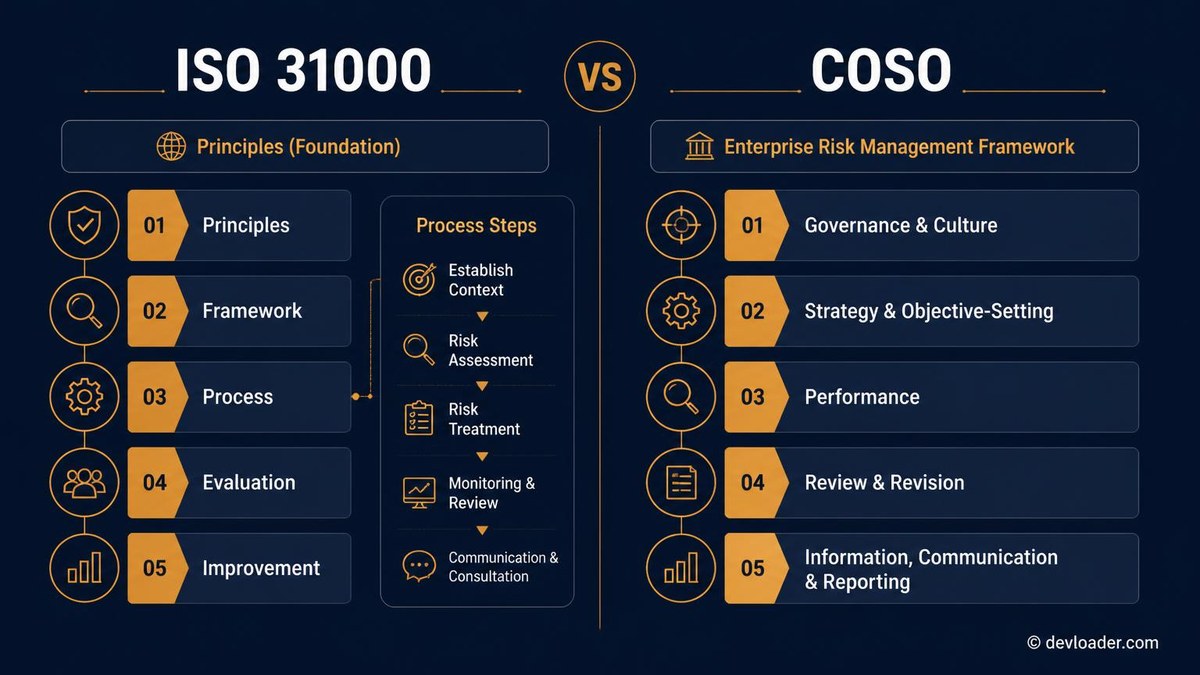
ISO 31000 — COSO ERM
Orientation — Principles and process — Controls and reporting
Best fit — Any organisation, any sector — Listed companies, regulated finance
Strength — Flexible, easy to embed — Auditable, board-ready reporting
Trade-off — Less prescriptive detail — Heavier to implement and maintain
Certification — Guidance, not certifiable — Widely referenced by auditors
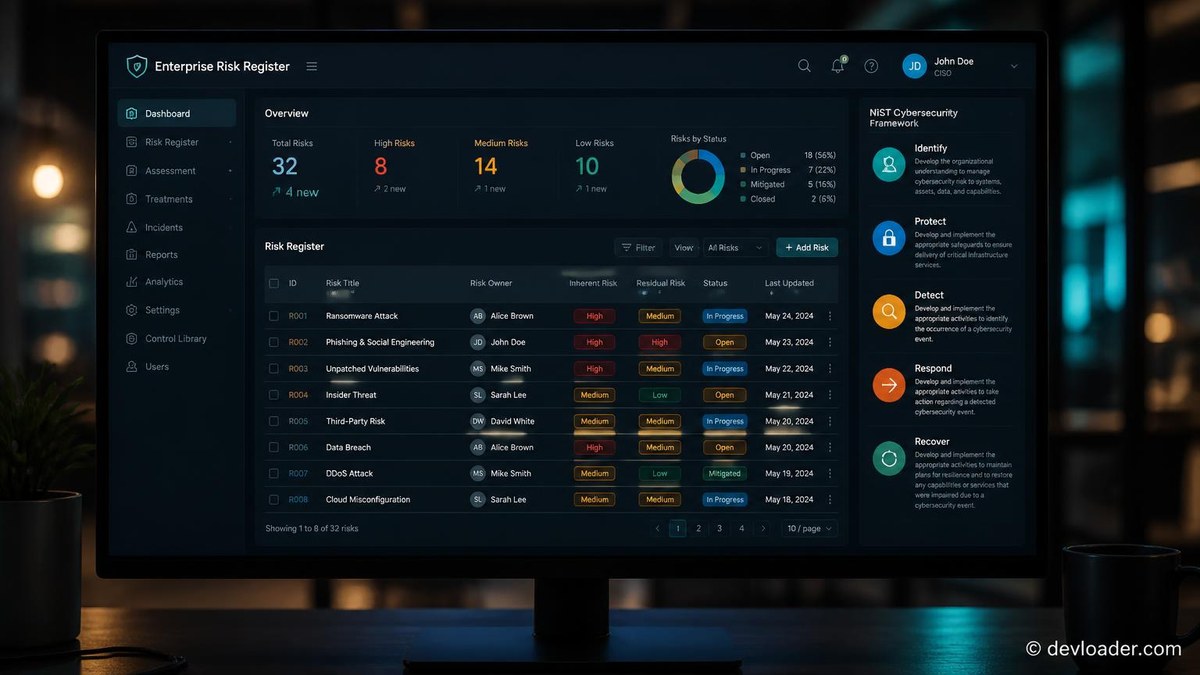
Neither model covers digital threat depth on its own. Layer the NIST Cybersecurity Framework core functions — Identify, Protect, Detect, Respond, Recover — over whichever enterprise model you pick. Those five functions turn "we take security seriously" into five testable capabilities, and they map cleanly onto ransomware and data-breach scenarios where most operational fallout now originates. If AI systems are in scope, pair this with formal AI governance responsibilities so model risk is registered like any other threat.
How to assess and analyse threats
Once the framework is chosen, evaluate your actual threat landscape.
A risk assessment prioritises effort. You are not trying to list everything — you are trying to find the small set of threats with the highest combination of likelihood and impact, and fix those first.
Qualitative analysis uses expert judgement and a scoring matrix (low / medium / high). It is fast, cheap, and good enough for most operational risks. Quantitative analysis assigns monetary values and probabilities — expected loss, value at risk, Monte Carlo simulation — and earns its cost where the numbers drive capital or insurance decisions.
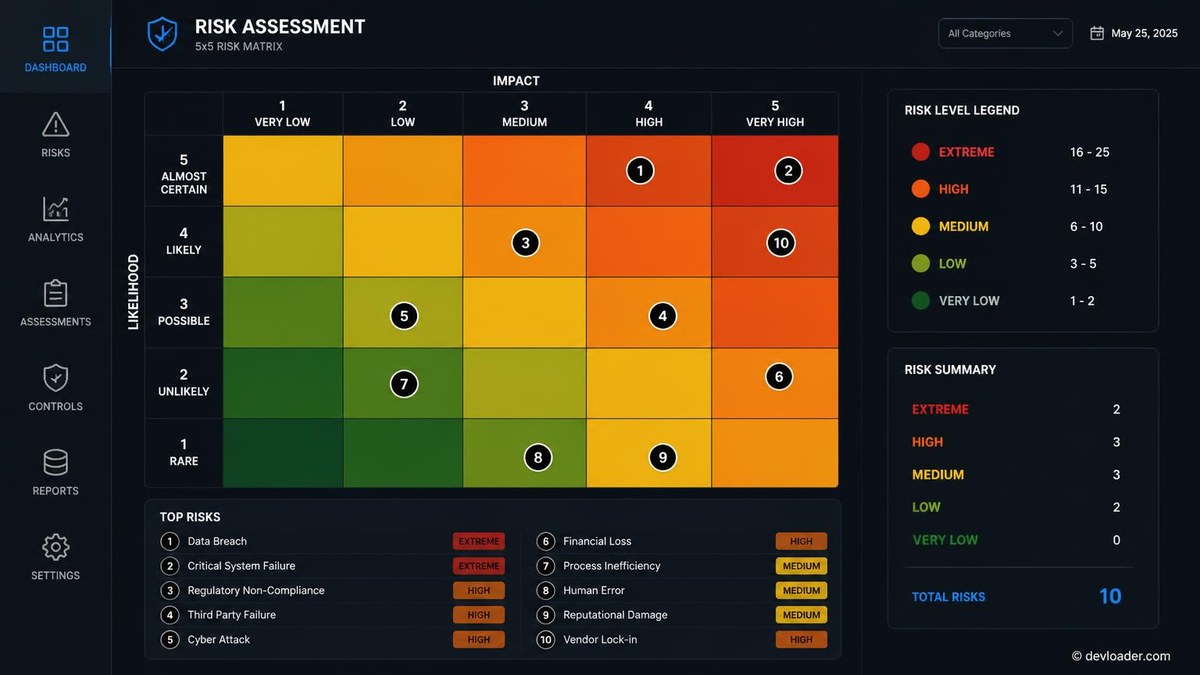
Two terms decide how you read the results:
- Inherent risk — the raw exposure before any control is applied.
- Residual risk — what remains once your safeguards are in place.
If residual risk still exceeds appetite, the control has failed regardless of how much it cost. Recording both is what makes a risk register useful: every entry carries an owner, an inherent score, the control, a residual score, a status, and a review date.
Implementation and response strategies
Moving from model to practice is a sequence, not an event:
- Define scope and appetite — agree what is in scope and how much risk is acceptable.
- Identify — run structured workshops across functions, not one email survey.
- Assess — score inherent risk, agree the top tier.
- Treat — assign a response, an owner, and a deadline to each priority risk.
- Monitor — track residual risk and control effectiveness on a fixed cycle.
- Review — refresh appetite and the register at board level, at least quarterly.
Each priority risk gets one of the four standard responses:
- Avoid — stop the activity, product line, or market entry creating the exposure.
- Reduce — lower likelihood or impact directly: replace legacy software, add MFA, dual-source a critical supplier, train staff.
- Transfer — shift financial impact to a third party through insurance or contractual indemnity. Note that reputation does not transfer.
- Accept — formally record that the exposure sits inside appetite and proceed, with a review date.
The discipline is in the word *formally*. Accepted risk that is never revisited becomes an incident with a paper trail proving you saw it coming.
Culture and continuous monitoring
The best-funded framework is only as strong as the people running it. A proactive risk culture — where raising a concern is rewarded rather than punished — produces earlier detection than any dashboard. Near-miss reporting is the single best leading indicator you can instrument.
The environment also never stops moving, so monitoring has to be continuous: automated control alerts, internal audits on a schedule, quarterly executive review, and an explicit trigger to reassess after any material change — a new market, a new vendor, a new system. Reliable monitoring, logging and error reporting in your own platform is part of that control set, not a separate engineering concern.
Conclusion
Choosing the right methodology is a strategic advantage, not a compliance checklist. Set an explicit appetite, pick a framework that matches your regulatory reality, score honestly, assign real owners, and review on a cycle. Do that and uncertainty stops being a threat to absorb and starts being an advantage you can price.
Build the systems your risk framework runs on
Dev Loader builds the internal tooling that makes governance operational — risk registers with owner accountability, control dashboards, audit logs, automated compliance alerting, and secure integrations with the systems you already use. If your framework currently lives in a spreadsheet, we can turn it into software your board will actually read.