Understanding AI Agent Development Cost: A Comprehensive Guide
Discover the true ai agent development cost with our comprehensive guide. Learn to navigate expenses, from talent and data prep to core technology and hidden costs, ensuring a budget-friendly AI strategy.
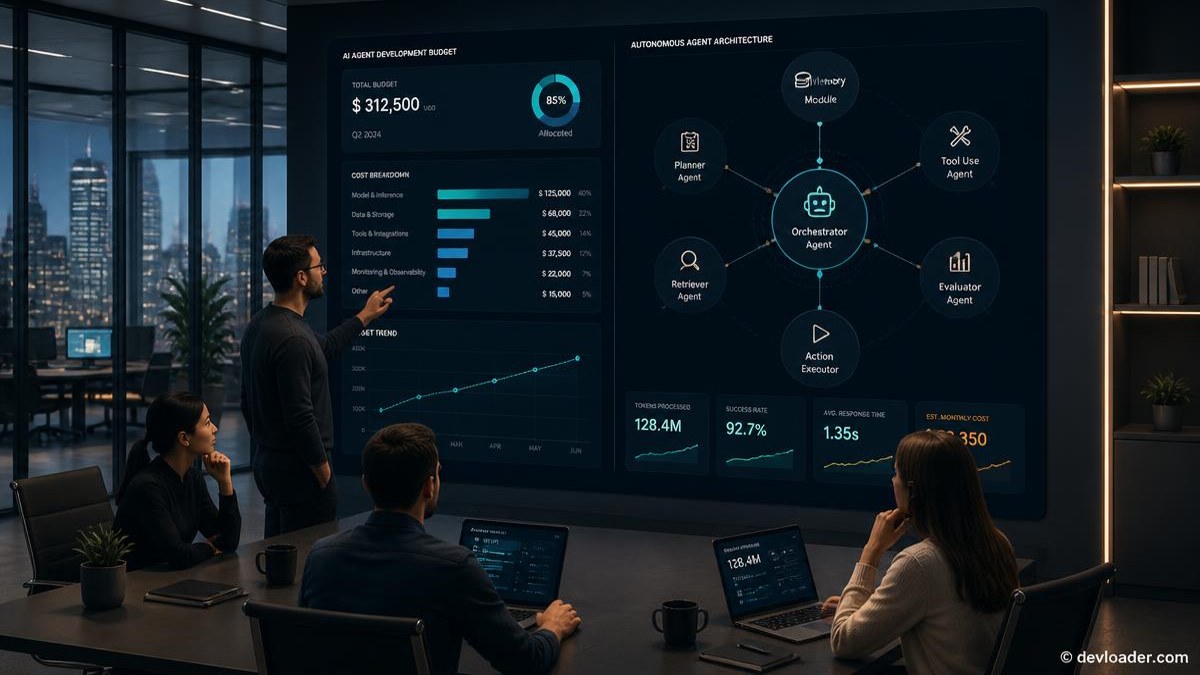
Artificial intelligence is reshaping how businesses operate, moving from passive software that waits for a click to autonomous assistants that execute entire workflows. As organisations rush to adopt it, one question dominates every budget meeting: what is the true ai agent development cost?
The honest answer is that the licence fee or the developer day rate is rarely the number that decides your total spend. Architecture, data quality and ongoing token consumption do. This guide breaks down every cost centre — talent, data preparation, core technology, and the running costs most teams discover only after launch — so you can plan realistically instead of revising your budget twice a quarter.
What we see costing teams the most
We scope and build agent systems for clients regularly, and the same three patterns drive overruns.
The first is data. Teams budget generously for engineering and almost nothing for getting their own knowledge base into a state a model can use. In practice, data extraction, cleaning and vectorisation frequently consume more hours than the agent logic itself.
The second is scope creep disguised as capability. "It should also raise the invoice" turns a retrieval agent into a system with write access to finance, which drags in approvals, audit logging and rollback handling — a different project at a different price.
The third is unmetered token spend. Nobody sets a ceiling, a retry loop fires in production, and the monthly API bill arrives at four times the forecast. A hard spend cap costs an hour to implement and repeatedly pays for itself.
The core dilemma: build vs buy AI agent software
Before any custom AI solutions pricing breakdown, settle the build vs buy AI agent software question. Buying a ready-made agent means monthly subscription fees, onboarding and implementation charges, and per-seat licensing. It is cheaper upfront and deploys fast.
Building a bespoke agent gives you complete control over data privacy, system integrations and unique functionality, in exchange for a higher initial investment. You are financing software engineering, model configuration and ongoing maintenance rather than a licence.
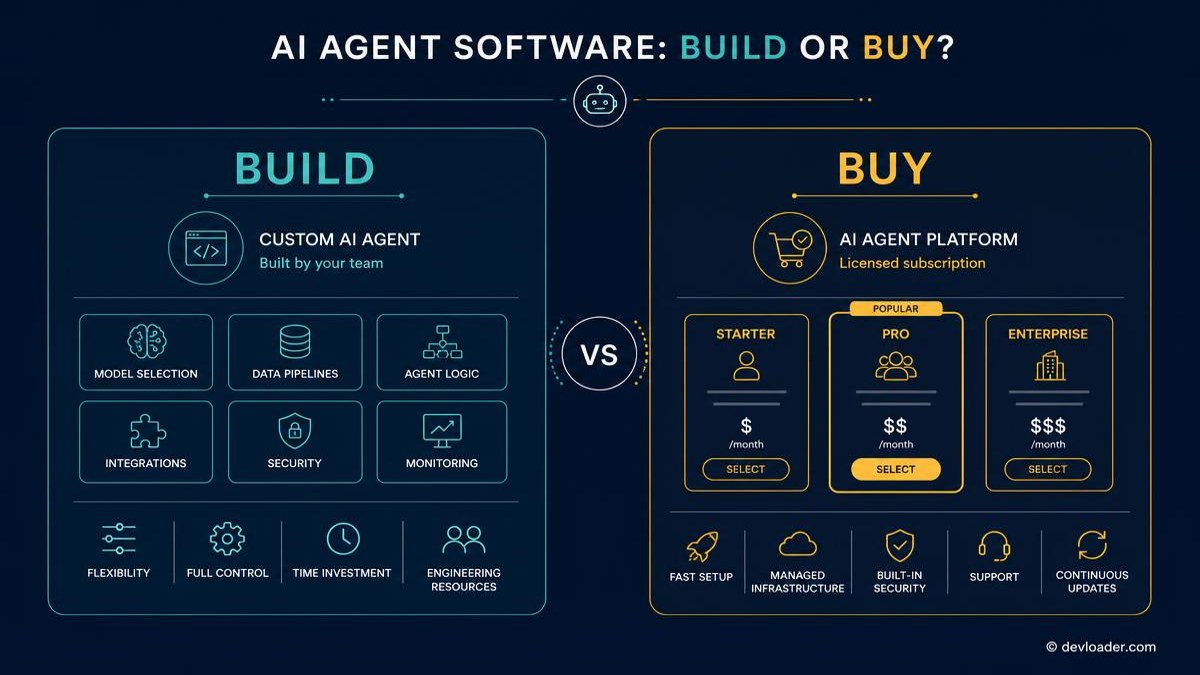
For highly specialised workflows or strict regulatory requirements, bespoke usually wins. It is also worth modelling the crossover point: at enterprise seat counts, recurring licence fees routinely overtake the lifetime cost of building. A hundred seats at $80 per month is $96,000 a year — the same order of magnitude as an MVP build you own outright. The same trade-off shows up in infrastructure choices, which is why the serverless versus edge functions decision deserves the same scrutiny as the model itself.
A custom AI solutions pricing breakdown
Talent and labour
Human expertise is the largest upfront line item in any software project. Hiring in-house means benchmarking AI developer salaries: machine learning engineers, data scientists and AI architects all command premium compensation, and they are slow to recruit.
Outsourcing to a specialised agency means evaluating artificial intelligence engineering hourly rates, which run from roughly $50 to well over $200 depending on geography, seniority and niche expertise. The cheapest rate is rarely the cheapest project — an engineer who has shipped retrieval pipelines before will avoid the architectural rework that doubles a timeline.
Data preparation
An AI agent is only as capable as the data it can reach. Budget deliberately for curation and cleaning: extraction from source systems, formatting, chunking, vectorisation and quality assurance. If your corporate knowledge sits in fragmented legacy systems, scanned PDFs or a decade of unstructured tickets, expect this to consume a meaningful share of the initial budget — and to be the single biggest determinant of answer quality.
Core technology and architecture
Your foundational technology choice moves the budget more than almost anything else. Proprietary models offer strong reasoning out of the box but generate ongoing API consumption charges tied to text volume. Open-weight models eliminate third-party API fees but raise your cloud bill sharply, because you are now renting GPUs to serve them. Prototyping on a free LLM API tier before committing is a cheap way to test that trade-off with real prompts.
Bringing internal knowledge into the agent adds retrieval-augmented generation costs: vector databases, embedding models and semantic search pipelines all need dedicated engineering, storage and continuous refinement as the underlying content changes.
Uncovering the hidden costs of AI agents
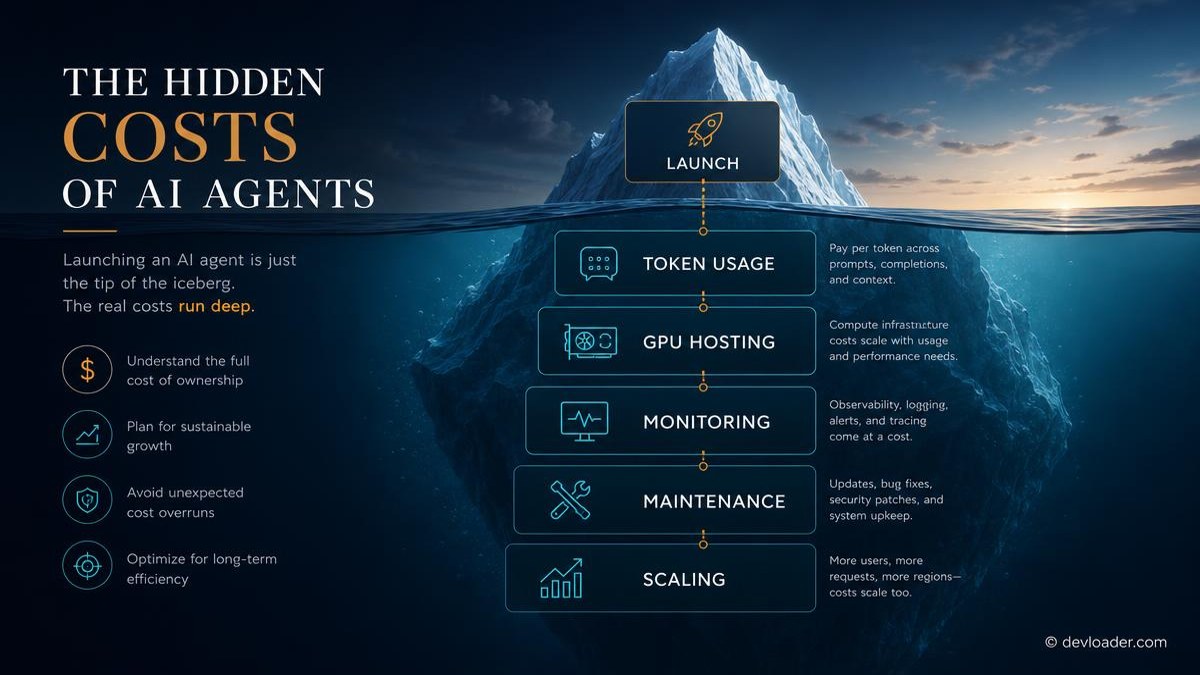
Most organisations miscalculate total cost of ownership by focusing on the launch. Running an autonomous system is a standing commitment.
Infrastructure and scaling
As usage grows and tasks become multi-step, infrastructure costs scale non-linearly. Compute demand spikes unpredictably at peak hours, and concurrency — not total volume — is what breaks capacity planning. Add the operational overhead of running virtual agents: monitoring, security patching, evaluation runs and regular updates that catch model drift or costly hallucinations before customers do. Treating that oversight as a formal control, in line with AI governance responsibilities, is what keeps an agent auditable as it scales.
Token usage and API optimisation
With hosted models, every prompt and response costs money. Without deliberate token optimisation — prompt compression, caching frequent queries, routing simple requests to smaller task-specific models — bills escalate quickly. A semantic cache that reuses previous answers for near-identical questions can cut spend substantially on support and FAQ workloads. Set a hard monthly ceiling in code, not just an alert.
Strategic planning: how to budget for generative AI projects
Adopt a phased approach so each release earns the next tranche of funding.
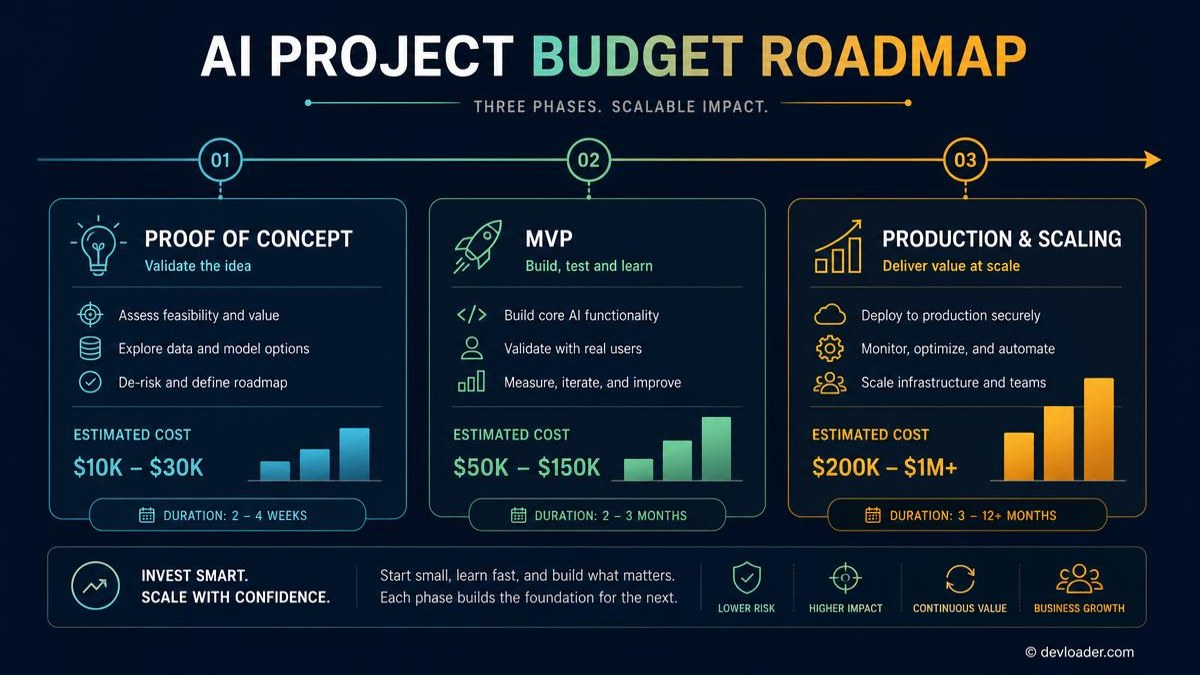
Phase 1 — Proof of concept. Roughly $10,000 to $30,000 over two to four weeks. Validate core functionality on off-the-shelf APIs before buying any infrastructure. The deliverable is evidence, not a product.
Phase 2 — Minimum viable product. Roughly $50,000 to $150,000 over two to three months. Integrate the agent with business systems, finish the interface, and establish secure data pipelines and evaluation harnesses.
Phase 3 — Production and scaling. From $200,000 upward for full enterprise deployment, covering security compliance, high-availability hosting, failover, observability and the support model.
Treat these as planning ranges, not quotes: a single-workflow internal agent lands at the bottom of each band, while a regulated, multi-system deployment sits well above it.
When presenting figures to executives, tie the ai agent development cost back to return on investment. Will the agent cut support resolution time by 40%? Will it remove hundreds of hours of manual data entry each month? Quantified labour savings and efficiency gains justify the investment far more reliably than capability demos. The same discipline that underpins risk management frameworks applies here — score the exposure, name an owner, and set a review date.
Conclusion
The real ai agent development cost depends on scope, the state of your enterprise data and your underlying architecture. Weigh engineering talent, API consumption and ongoing maintenance against the efficiency gains, budget in phases, and put spend controls in place before launch rather than after the first surprise invoice. Do that, and an agent programme becomes a predictable investment instead of an open-ended one.
Build your AI agent with a team that scopes it honestly
Devloader designs and ships production AI agents — retrieval pipelines, tool use and function calling, provider failover, prompt caching, spend controls and the observability that keeps all of it accountable. We start with a fixed-price discovery so you see the real number before you commit to a build.