AI Sales Assistant: Revolutionize Sales with AI Tools
Transform your sales strategy with an AI sales assistant—boost productivity, streamline processes, and increase win rates. Discover top AI sales tools and solutions to accelerate your success today!
Quotas are up, buying committees are bigger, and the average B2B deal now takes more touches than it did three years ago. That is the gap an AI sales assistant fills. It is not a replacement for a good rep — it is the layer that removes the 60% of the week reps spend on research, data entry, scheduling and note-taking, so the remaining time goes into conversations that actually close.
This guide covers what an AI sales assistant does across prospecting, CRM hygiene and live calls, how to measure whether it is working, and how to choose one without buying a tool your team quietly abandons in month three.
How we evaluated AI sales assistants
We run the same evaluation for clients that we run internally before adopting anything into our own pipeline. Every tool gets a 30-day pilot with a single team, a written baseline captured before the pilot starts (hours logged in CRM per rep per week, meetings booked, average first-response time, and win rate on the segment), and a hard adoption threshold: if weekly active usage sits under 40% at day 30, the tool is cut regardless of how good the demo was. Scoring weights CRM write-back reliability, data residency and retention terms, and whether the vendor exposes an API we can wire into existing workflows. Tools that only work inside their own walled UI score poorly, because reps will not leave the CRM to use them.
Prospecting: automated outreach vs manual research
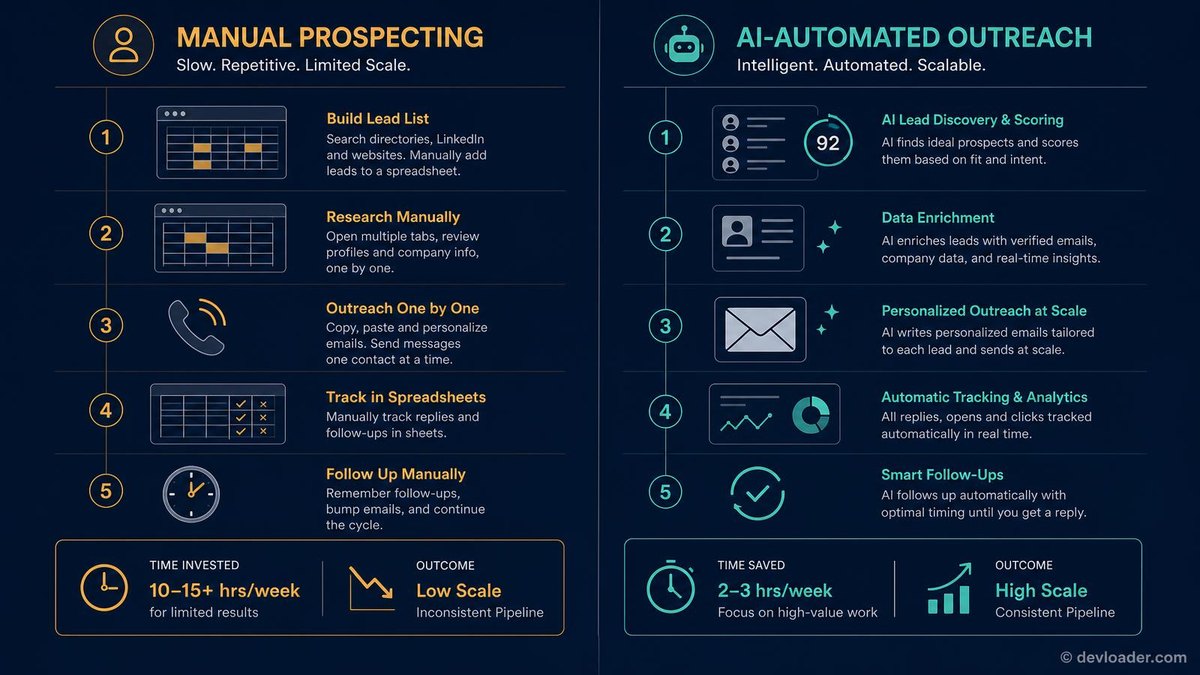
When teams compare automated sales outreach with manual prospecting, the argument usually ends on volume — but the real difference is *ordering*. Manual prospecting works a list top to bottom. Predictive lead scoring works it by likelihood to buy, using firmographic fit plus behavioural intent signals: pricing-page visits, repeat doc views, hiring signals, technology changes.
That reordering is where the win-rate lift comes from. A rep who calls the top decile of a scored list is having a materially different conversation than one who calls alphabetically.
Where AI sales automation genuinely helps in prospecting:
- Lead discovery and scoring — surface accounts matching your closed-won profile before a competitor does.
- Enrichment — verified contact data, org charts and recent triggers attached to the record automatically.
- Personalised outreach at scale — drafts grounded in a real signal (a job posting, a funding round, a stack change), not a merge field.
- Smart follow-up sequencing — timed bumps that stop the moment a human replies.
The failure mode is obvious and worth naming: personalisation that is technically dynamic but obviously templated performs worse than a short honest email. Keep a human review step on the first send to any tier-one account.
CRM hygiene and pipeline management
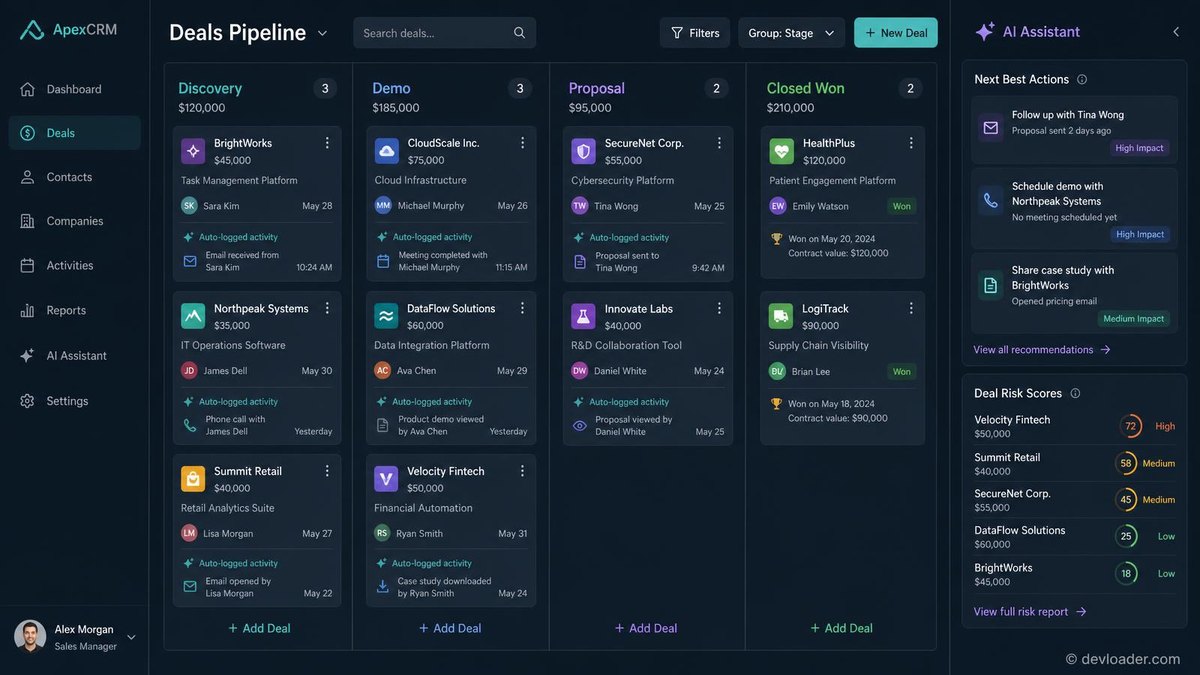
Ask any account executive what they hate and "updating the CRM" is in the top two. It is also where AI pays back fastest, because the work is high-volume, low-judgement and fully observable.
A modern assistant logs calls, emails and meetings against the right opportunity automatically, extracts next steps from the transcript, and updates close dates when the evidence changes. On top of that clean data it can do the thing managers actually want: flag deals that have gone quiet, score risk per opportunity, and forecast against activity rather than rep optimism.
If you are building this kind of automation into your own stack rather than buying it, the patterns in our guide to building AI workflows with an AI agent builder apply directly — the orchestration layer is the same whether the agent is serving sales or operations.
Live calls: conversational intelligence and real-time coaching
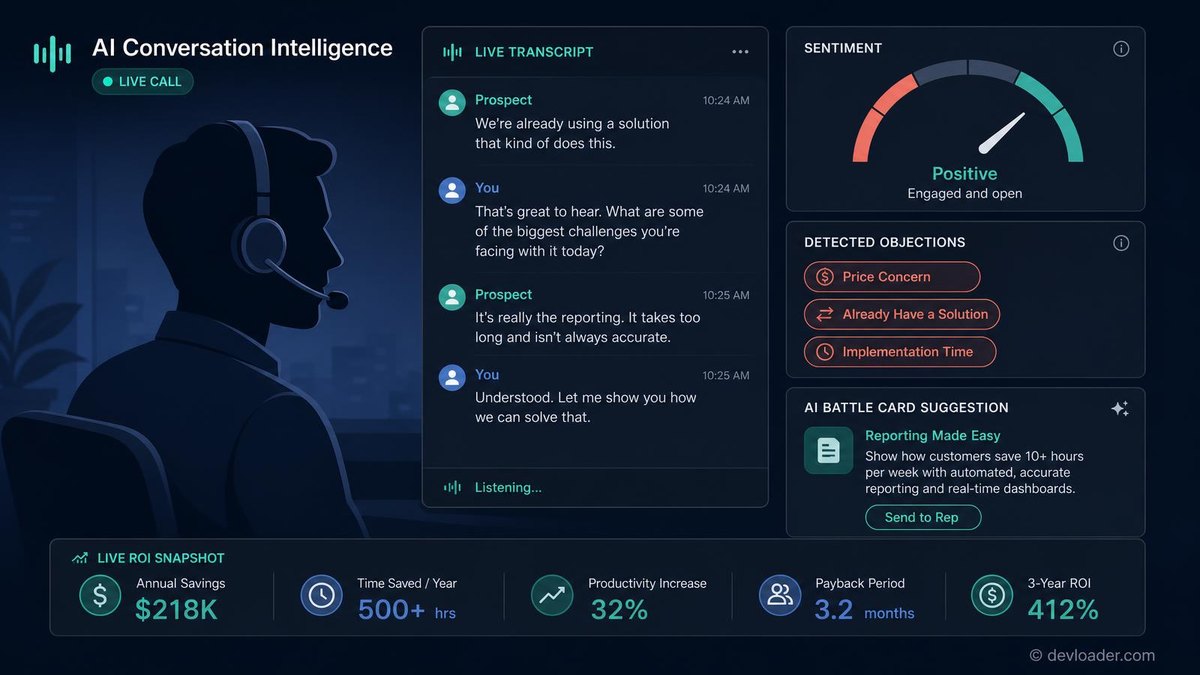
Natural language processing is now good enough to be useful mid-call, not just after it. A capable AI sales call assistant transcribes in real time, tracks talk-to-listen ratio, detects objections as they surface, and pushes the relevant battle card to the rep's screen before the moment passes.
The post-call value is arguably larger. Every call becomes searchable, so you can answer questions no CRM field ever captured: how often does the incumbent competitor come up in deals we lose? Which objection appears in stage three but never in stage one? That is coaching material for the whole team, sourced from evidence instead of anecdote.
Pair it with automated scheduling and the calendar ping-pong disappears too. If your team also handles inbound support conversations, the same conversational layer underpins a modern AI-powered customer care chatbot — one deployment, two revenue-adjacent functions.
What the benefits actually look like in numbers
Skeptics ask a fair question: does any of this move revenue in a relationship-driven business? Track four things and you will know within a quarter.
Metric — What to baseline — What good looks like
Selling time — Hours per rep per week on admin — 4–8 hours returned
Response speed — Median time to first touch on inbound — Minutes, not hours
Win rate — Conversion on scored vs unscored leads — Measurable lift on the top decile
Forecast accuracy — Variance between forecast and actual — Narrowing month over month
Multiply the hours returned by the fully loaded cost of a rep, compare it to licence plus implementation, and require a payback period under 12 months before rolling out company-wide. If a vendor will not let you measure that in a pilot, that is your answer.
Choosing and implementing the right software
There is no single best AI sales assistant — there is the one that fits the motion you already run. Outbound SDR teams need volume, deliverability and sequencing. Enterprise AEs need account intelligence, multithreading visibility and clean forecast data. A two-person founder-led sales team usually needs scheduling and CRM write-back and nothing else.
Whatever you shortlist, insist on:
- Native CRM write-back, not a one-way export.
- Documented data handling — retention windows, training opt-out, and a GDPR/CCPA posture you can show a security reviewer.
- An open API, so the assistant can be wired into the rest of your stack.
- Rollout support — a named owner, a written playbook and adoption tracking from week one.
Most failed deployments are not tool failures; they are change-management failures. Pick one workflow, prove it, then expand. For a broader view of where a sales assistant sits alongside analytics, support and automation platforms, see our breakdown of the top 10 AI tools for business.
Build it into your revenue stack with Dev Loader
At Dev Loader LLC we build and integrate AI-assisted revenue tooling for teams that have outgrown off-the-shelf software: CRM automation, lead scoring pipelines, conversational intelligence integrations, and custom agents wired into the systems you already run. Every engagement starts with the same measurement discipline described above — baseline first, pilot second, roll out only what proves out.
If you want an AI sales assistant that fits your pipeline instead of forcing your team to fit the tool, tell us about your sales stack and we will come back with a scoped proposal, a timeline and a fixed quote within 48 hours. You can also browse our engineering and automation services to see how we approach integration work.