Top Agentic AI Frameworks: Compare the Best
Discover the power of agentic AI frameworks in transforming AI from passive responders to proactive problem-solvers. Explore top frameworks, comparisons, and open-source options for building intelligent multi-agent systems.
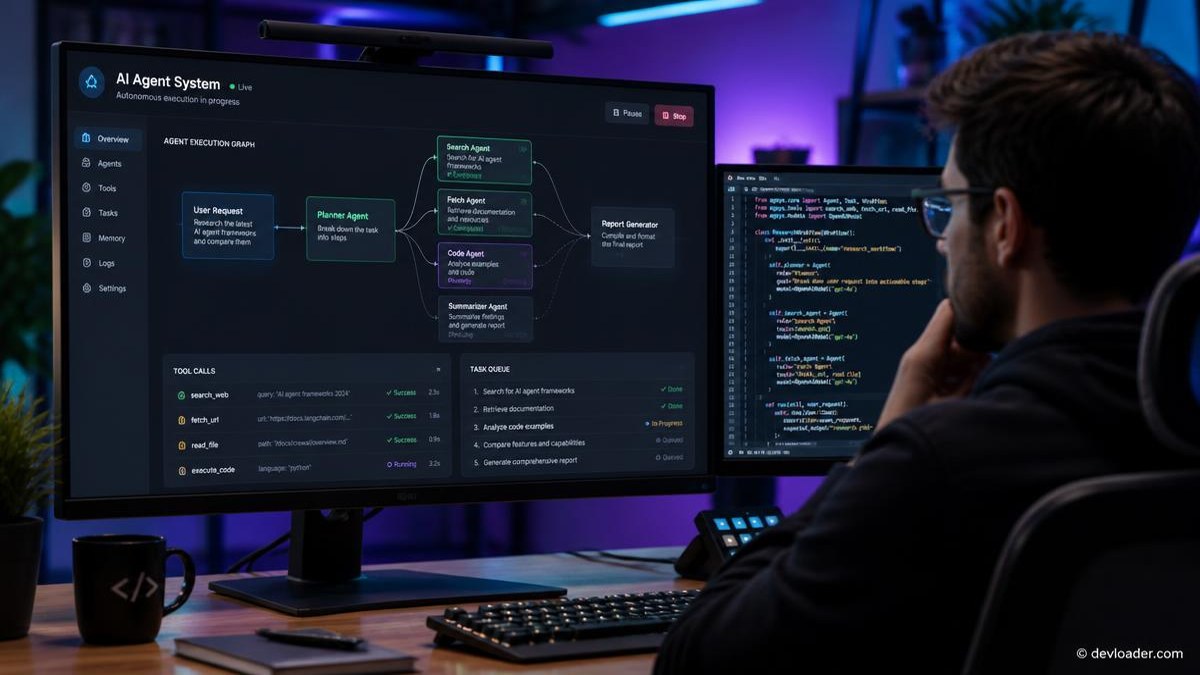
Artificial intelligence is shifting from passive responder to proactive problem-solver, and agentic AI frameworks are what make that shift practical. If you have wondered how agentic reasoning works inside large language models, the idea is simpler than the jargon suggests: instead of generating one answer to one prompt, the model plans a sequence of steps, calls real tools to execute them, checks its own results, and iterates until the goal is met or a limit is hit.
That loop is the whole difference between a chatbot and a digital worker that can finish a multi-step job with light supervision.
What we learned shipping agentic systems for clients
We build and maintain agent-based automations for client products, and three lessons repeat on every engagement.
First, scope kills more agent projects than model quality. The systems that survive contact with production own one bounded workflow — triage these tickets, reconcile these invoices, draft this weekly report — with a clear definition of done. "An agent that runs the business" never ships.
Second, tools matter more than prompts. An agent is only as capable as the functions you expose to it, and every function needs validated inputs, timeouts, and an idempotency story. Most "hallucinating agent" reports we investigate are actually a tool returning an unhelpful error the model then improvised around.
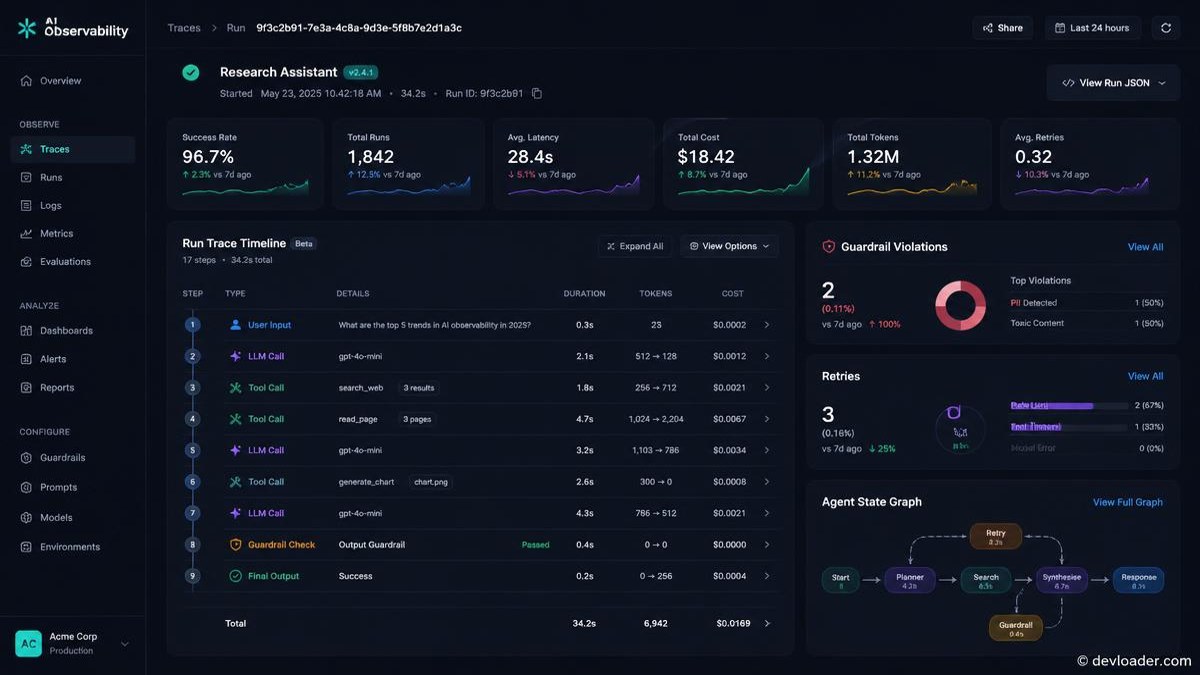
Third, budget for observability from day one. Without per-step traces, token cost, and retry counts, you cannot tell a failing agent from a slow one, and you cannot defend the spend.
Moving beyond traditional RAG pipelines
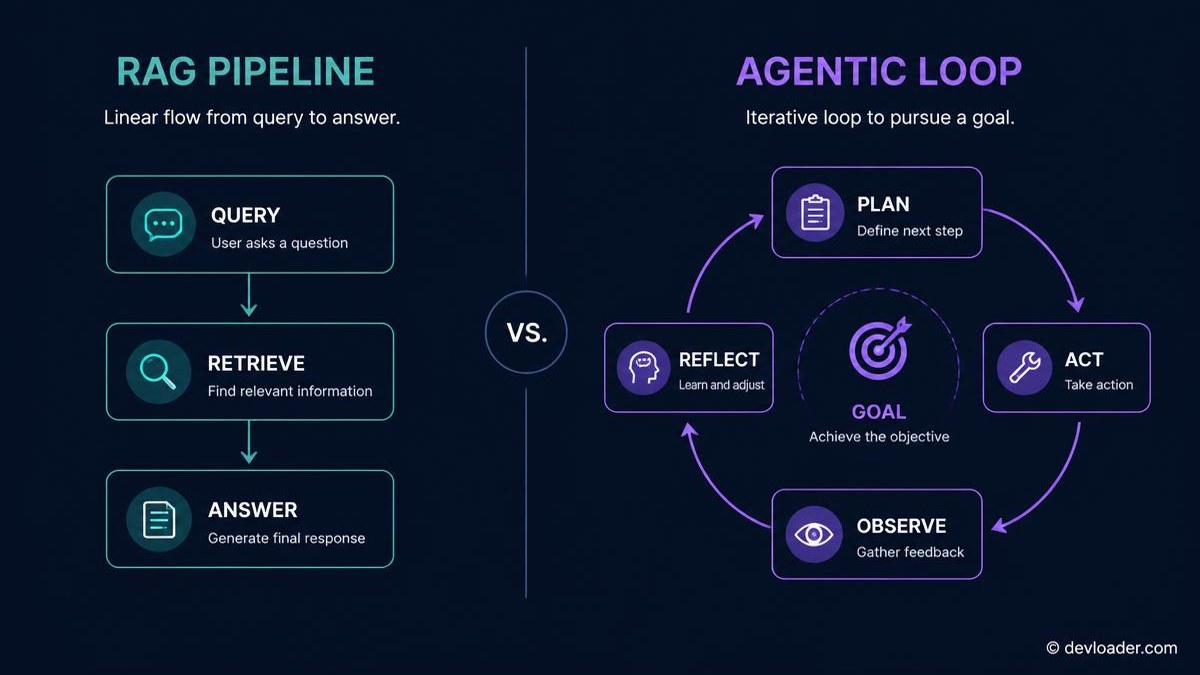
Comparing autonomous agents with traditional Retrieval-Augmented Generation pipelines makes the operational difference obvious. A RAG pipeline is reactive: it retrieves relevant context and answers the question in front of it. An agentic system is goal-directed: it decides what to do next, does it, and reassesses.
The benefits of agentic workflows follow from that loop — continuous problem-solving, adaptation when the environment changes, and genuine end-to-end automation instead of a human stitching outputs together. Researching a competitor, pulling pricing data, and drafting a market analysis becomes one run rather than nine copy-paste steps.
The trade-off is real, though. Loops cost more tokens, fail in more interesting ways, and need guardrails. Use RAG when the job is "answer accurately from our documents." Reach for agents when the job is "get this done."
Core mechanics of frameworks for building AI agents
Every serious framework for building AI agents assembles the same five primitives.
- Task decomposition. The model breaks an ambiguous goal into ordered, checkable steps before acting.
- Tool calling and function execution. Typed functions let the agent query a database, hit an API, send an email, or search the web.
- Persistent memory. Structured short-term and long-term memory keeps context across a long run instead of resetting each turn.
- Self-correction and reflection. A critique step catches bad output early and cuts hallucination in autonomous workflows substantially.
- Safety guardrails. Allowlisted tools, spend caps, step limits, and human approval on destructive actions keep the system inside its lane.
If you are new to the underlying modelling work, our step-by-step guide to creating an AI covers the data and training layer that sits beneath all of this.
Navigating the framework landscape
Picking the best AI agent framework depends on scope and team skill, not on benchmark screenshots. In practice the ecosystem splits into two categories.
Lightweight scripting libraries give you a thin loop, tool bindings, and little else. They are fast to learn, easy to debug, and ideal for one focused workflow.
Orchestration platforms add state machines, retries, queues, human-in-the-loop steps, and tracing. They cost more upfront and pay for themselves the moment an agent needs to survive a failed API call at 3am.
Framework — Best for — Control level — Learning curve
LangGraph — Stateful, graph-based agents with cyclic reasoning — Very high — Steep
CrewAI — Role-based teams shipped quickly — Medium — Gentle
AutoGen — Conversational multi-agent research and negotiation — High — Moderate
OpenAI Agents SDK — Tool-heavy single agents on one provider — Medium — Gentle
LlamaIndex Workflows — Data- and retrieval-centric agents — Medium-high — Moderate
Most teams overestimate how much control they need in month one and underestimate how much they need in month six. Prototype with the gentlest option, then migrate the workflow that proves valuable.
The power of multi-agent systems
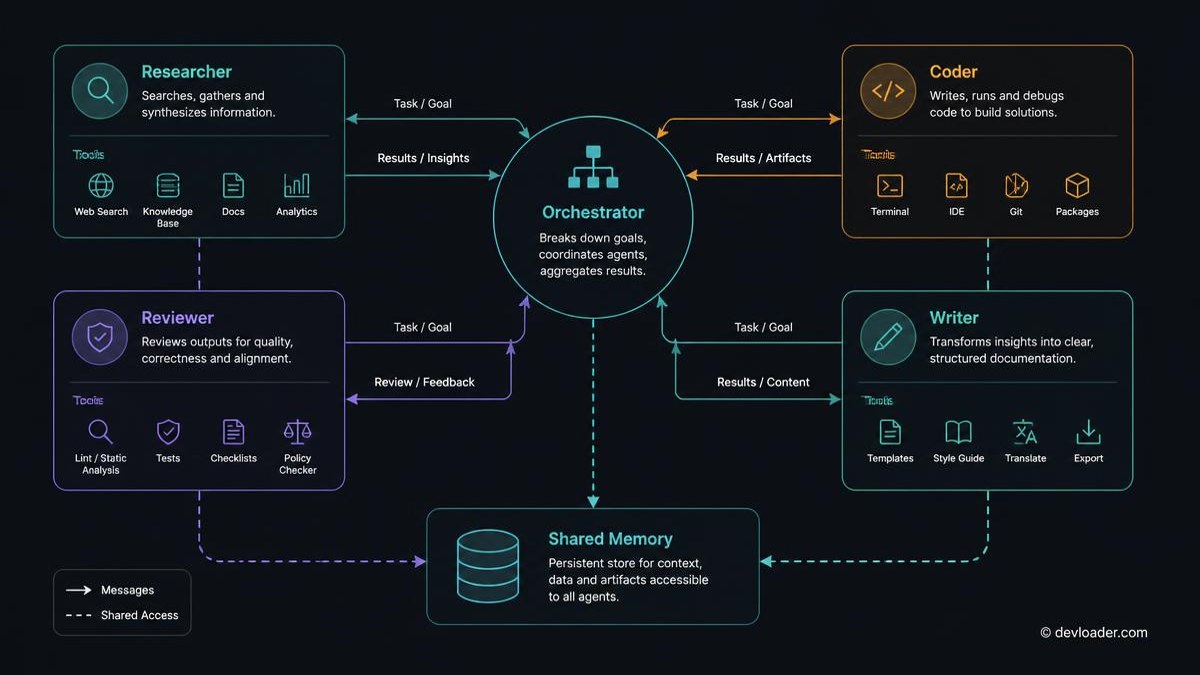
One model rarely handles an entire business process well. Multi-agent frameworks let you build a digital team: a researcher gathers documentation, a coder writes the script, a reviewer checks it, a writer packages the result. Each role gets its own instructions, its own tools, and a narrower failure surface.
The determining factor when choosing the best multi-agent framework is how cleanly those roles communicate and how state is shared. Message passing with a shared memory store scales; free-form chat between five agents usually does not.
A word of caution from experience: multi-agent architectures multiply cost and latency. Start with one agent and add a second role only when you can name the specific failure it prevents.
Embracing the open-source ecosystem
Open-source agentic AI frameworks dominate this space, and almost every serious option is a Python AI agent framework — Python's data ecosystem simply makes it the default. Open source lets you read the reasoning loop, patch it, pin versions, and run locally when data cannot leave your network.
When evaluating an open-source agent framework, weight documentation quality, release cadence, and how many production users appear in the issue tracker. A clever architecture with a stale changelog is a maintenance liability.
Teams comparing the wider tooling landscape may also find our roundup of AI tools that move the needle for business and our review of AI coding assistants useful when deciding what to build versus buy.
LangGraph vs CrewAI: the recurring debate
Nearly every agent framework comparison lands on LangGraph vs CrewAI, and the answer is genuinely situational.
LangGraph models your agent as an explicit graph of nodes and edges with durable state. You control routing, cycles, retries, and checkpoints. That precision is exactly what you want for a compliance-sensitive workflow — and exactly what makes the first week slower.
CrewAI models the problem as roles and tasks. You describe a crew, assign goals, and get a working prototype in an afternoon. It is the faster path to a demo and to many production workflows that are not state-heavy.
A pragmatic rule: prototype in CrewAI, and move to LangGraph when you find yourself fighting the abstraction to express branching or recovery logic.
Putting an agent into production
A checklist we apply before any agent handles real work:
- Cap the loop. Maximum steps, maximum spend, maximum wall-clock time — enforced in code, not in the prompt.
- Log every step. Inputs, tool responses, token cost, and duration, stored where you can query them later.
- Make tools boring. Validate arguments, return structured errors, and make writes idempotent.
- Gate destructive actions. Anything that spends money, emails a customer, or deletes data goes through human approval until the success rate earns autonomy.
- Evaluate continuously. Keep a fixed set of scenario runs and score them on every prompt, model, or framework change.
If your agent will answer customers directly, the delivery layer matters as much as the reasoning layer — see how we approach AI-powered customer support and AI sales assistants for revenue-facing workflows, or our guide to building AI workflows with an agent builder for the low-code path.
Final thoughts
The move toward agentic capability is changing how businesses automate real work — from decomposing cognitive tasks to running collaborative agent teams. Choose the framework that matches your control requirements, keep the first scope embarrassingly narrow, and instrument everything. Whether you land on a lean open-source Python library or a full orchestration platform, the direction of travel is clear: software is becoming agentic.
Build your agentic AI workflow with Dev Loader
Dev Loader LLC designs and ships production agent systems — tool integrations, guardrails, observability, and the boring reliability work that keeps them running. If you are evaluating agentic AI frameworks for a real workflow, we can help you scope it, pick the stack, and get it live.
Request a project quote or explore our development services to start the conversation.